How Much Fuel Economy Does Cylinder Deactivation Save in a Truck?
Cylinder deactivation in a light-duty truck can save fuel, but the payoff is usually modest: best on steady highway driving, smaller in mixed use, and often near zero when the truck is towing or hauling hard. In practical terms, the feature can trim fuel use enough to matter for high-mileage drivers, but it is not a cure-all for a heavy truck. This guide breaks down the realistic MPG, gallon, and dollar gains, then shows when cylinder deactivation works and when it fades out.
Cylinder deactivation in trucks
Cylinder deactivation shuts off some cylinders under light load, then brings them back when the truck needs more power. In a pickup, that can mean V8-to-V4 or similar mode changes on a steady cruise. It works best when the throttle stays light and the engine can hold a steady speed.
That is why the system matters most on highways and long, flat commutes. It is common on GM truck engines that use AFM or DFM, and it also appears on some Ram, Dodge, and Chrysler engines that use MDS, plus some Honda applications that use VCM, although those are more often associated with SUVs and vans than with pickups. When oil level, oil pressure, or a control fault gets in the way, the system may stop operating as intended.
How the system saves fuel
When fewer cylinders fire, the engine moves less air through pumping losses and burns less fuel to hold the same road speed. The gain comes from light-load operation, not from power on demand. As soon as the driver asks for more torque, the system reactivates the cylinders.
Factory systems often work only in certain gears or steady RPM conditions. That limits how often they can stay in the fuel-saving mode. Trucks with more advanced cylinder management can do more, but the street result still depends on how the truck is driven.
Which truck engines commonly use it?
Many truck buyers know it from Chevy and GMC V8s, especially the full-size pickup lineup, where AFM and DFM are the most familiar names. Ram, Dodge, and Chrysler applications use MDS on some V6 and V8 engines, while Honda’s VCM is more common in SUVs and vans than in trucks. The feature shows up wherever the engine can spend a lot of time at partial load, where the system has a chance to help.
How much fuel does cylinder deactivation actually save in a truck?
In a truck, the realistic gain is usually modest in normal street use and larger only in steady highway driving. A good working range is about 1 to 3 mpg on the highway, less in mixed traffic, and often very little while towing or hauling. That is enough to matter for high-mileage drivers, but not enough to transform a heavy truck into a small car.
Realistic MPG gain range for pickups
For a light-duty pickup, the benefit usually shows up as a percentage gain on top of the truck’s normal fuel economy, not as a fixed number for every engine. That matters because a truck that starts at 15 mpg has less room to save than one that starts at 22 mpg. In steady highway cruising, the best-case gain can be meaningful; in mixed real-world use, the average is usually smaller.
Some GM 6.2L V8 testing has shown strong results for more advanced cylinder management, but that kind of figure reflects controlled conditions rather than a promise for every pickup on the road. A lab result can point to the technology’s ceiling, while a street truck still has to deal with traffic, grades, payload, temperature swings, and towing.
Why the gain shrinks in city driving and towing
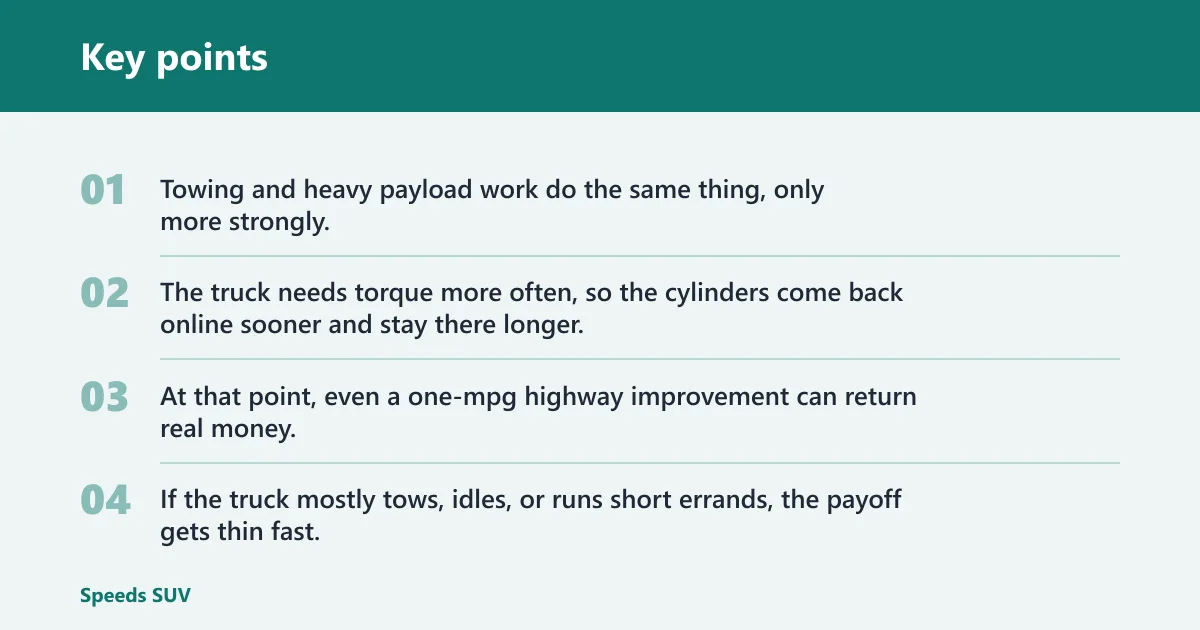
Stop-and-go traffic keeps the engine changing load and speed, which gives the system fewer long steady windows to stay in deactivation mode. Towing and heavy payload work do the same thing, only more strongly. The truck needs torque more often, so the cylinders come back online sooner and stay there longer.
Suppose a half-ton pickup cruises at 20 mpg on the highway with deactivation active, but drops to 16 mpg in mixed driving. A 1 mpg gain matters more at 20 mpg than at 16 mpg in terms of percentage, yet the city route may still feel unchanged at the pump because the engine spends little time in the savings mode.
When the savings are large enough to matter
For many owners, the gain becomes meaningful once the truck sees 8,000 to 15,000 miles per year and spends a lot of that time cruising. At that point, even a one-mpg highway improvement can return real money. If the truck mostly tows, idles, or runs short errands, the payoff gets thin fast.
Truck savings calculator
The table below uses simple example baselines for a light-duty truck and a fuel price of $3.50 per gallon. The fuel math is straightforward: annual gallons saved = annual miles × (1 ÷ baseline MPG − 1 ÷ improved MPG), and annual dollars saved = annual gallons saved × fuel price. It shows how annual savings change by use case, not a promise for every engine. The towing row is intentionally conservative because many trucks see little or no benefit under load.
| Driving condition | Example truck baseline | Example MPG gain | Gallons saved per 100 miles | 8,000 miles/year | 12,000 miles/year | 15,000 miles/year |
|---|---|---|---|---|---|---|
| Highway cruising | 20 mpg to 21.5 mpg | 1.5 mpg | 0.35 gal | 28 gal, $98 | 42 gal, $147 | 52 gal, $183 |
| Mixed driving | 16 mpg to 17 mpg | 1.0 mpg | 0.37 gal | 29 gal, $103 | 44 gal, $155 | 55 gal, $193 |
| City use | 14 mpg to 14.5 mpg | 0.5 mpg | 0.25 gal | 20 gal, $69 | 30 gal, $105 | 37 gal, $129 |
| Towing | 12 mpg to 12.1 mpg | 0.1 mpg | 0.07 gal | 6 gal, $19 | 8 gal, $29 | 10 gal, $36 |
These numbers are estimates from the fuel math, not road-test claims. The takeaway is simple: the more of your driving is steady highway mileage, the more likely cylinder deactivation is to pay back in gallons and dollars. Under towing or heavy payload use, savings can fall to almost nothing.
Does it pay off in your use case?
Yes, if your truck spends a lot of time cruising with light throttle and few load changes. No, if most of the mileage is short trips, towing, or stop-and-go traffic. The payoff depends less on the badge on the tailgate than on how often the engine can stay in its low-load mode.
Highway commuting and long-distance use
This is the best case. A steady commute at 60 to 75 mph gives the system more time to stay active, so the fuel saving has room to show up. If your truck racks up long interstate miles, cylinder deactivation can pay back more of the price difference on certain trims or engines.
Mixed driving and short-trip use
Mixed driving cuts into the gain because every start, merge, and slowdown interrupts the low-load window. Short trips are worse, especially when the engine never warms fully. In that pattern, the system may work, but the savings may be too small to notice without careful fuel logs.
A common first-timer mistake is expecting a city pickup to behave like a highway commuter. A 5-mile errand loop with traffic lights and cold starts rarely gives deactivation enough steady time to matter, even if the truck has the feature turned on.
Towing, hauling, and stop-and-go traffic
Towing and heavy payload work usually erase most of the advantage because the engine must stay ready for torque. Stop-and-go traffic does the same by forcing constant mode changes. If your truck is a work tool first, cylinder deactivation is still useful hardware, but it is not where most of your fuel savings will come from.
What changes when it stops working?
When the system faults, the truck usually keeps running on all cylinders by default. That protects drivability, but it also means the fuel-saving mode is gone or limited. In that state, the truck can lose the MPG benefit and may also trigger a diagnostic code such as P3400.
P3400 trouble code and reduced fuel economy
P3400 points to a fault in the cylinder-deactivation system on one bank, so it is not a full diagnosis by itself. It is still a strong clue that the engine is no longer switching cylinders as intended, and that can mean reduced fuel economy. The truck may remain driveable, but the fuel-saving mode may be unavailable until the underlying problem is fixed.
Because the engine continues running on all cylinders by default, the truck usually stays driveable. The fuel bill can still rise if the system has been stuck out of service for a while. That makes the code worth checking even if there is no obvious drivability complaint.
Oil level, oil pressure, and contaminated oil
Low oil can disable cylinder deactivation, and reduced oil pressure can trigger faults. Contaminated oil is a common issue in the diagnosis path. The oil level should be checked first, because the system depends on oil flow to operate the valvetrain hardware.
If the oil pressure sensor is reading incorrectly, the PCM may shut the system down as a precaution. That can leave the truck running normally while quietly losing fuel economy. It can also point you toward a sensor or wiring problem rather than a mechanical failure.
Solenoids, sensors, wiring, and PCM faults
Cylinder deactivation solenoids control oil flow in the system. If they stick or fail, the cylinders may not switch correctly. Sensors, wiring, and the PCM can also stop the system from commanding the right mode at the right time.
- Check the oil first. Verify the oil level on level ground and inspect the oil condition. If the oil is low, dirty, or overdue, fix that before chasing deeper faults because oil supply is central to the system.
- Scan for stored codes. Look for P3400 and related engine or oil-pressure codes. The code does not name every failed part, but it narrows the diagnosis to the deactivation system and its inputs.
- Inspect the control hardware. Check the cylinder deactivation solenoids, connectors, and wiring for damage, corrosion, or loose fit. Solenoids can be tested for clicking or vibration, which helps separate an electrical command issue from a stuck actuator.
- Verify pressure signals. Confirm the oil pressure sensor reading matches the engine condition. If the signal is wrong, the PCM may keep the system off even when the mechanical parts are fine.
GM 6.2L DSF savings
Dynamic Skip Fire is more advanced than basic factory cylinder deactivation. Instead of switching an entire bank or a fixed set of cylinders, DSF can deactivate cylinders individually on demand and works on a cycle-by-cycle basis. That gives it more control over combustion stability and load matching.
How DSF differs from basic cylinder deactivation
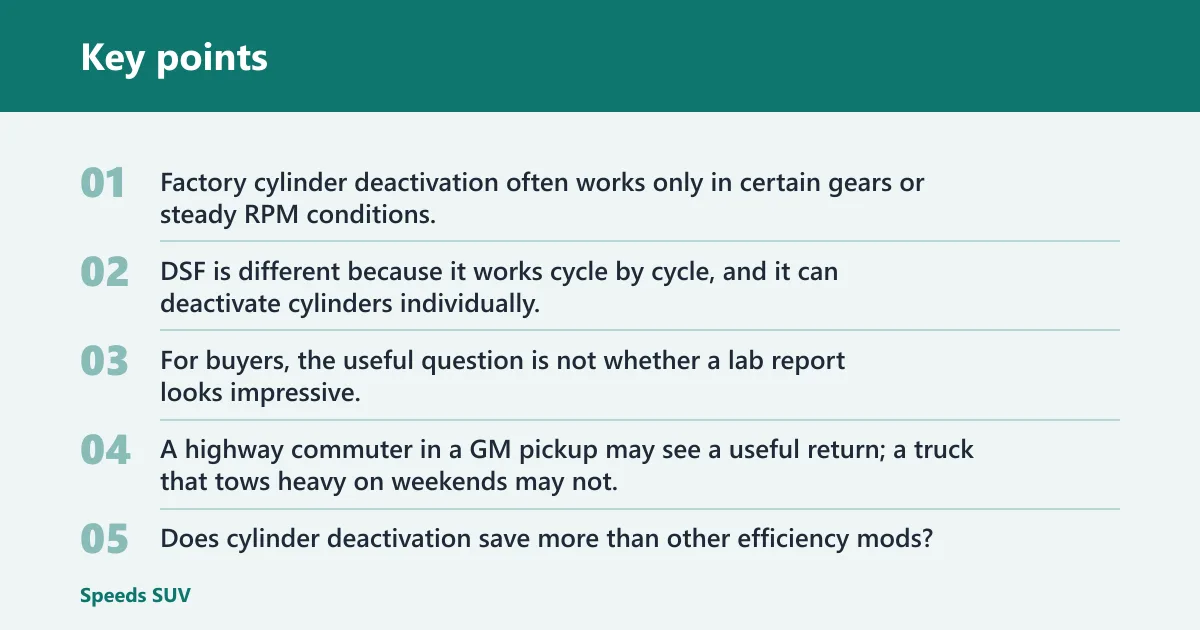
Factory cylinder deactivation often works only in certain gears or steady RPM conditions. DSF is different because it works cycle by cycle, and it can deactivate cylinders individually. That finer control is why the system can do better in lower-load conditions than a simpler on-off setup.
What the lab data says about the 18% result
Tula tested the system on a General Motors 6.2-liter V8 engine, and the lab work showed a substantial fuel-economy improvement under controlled conditions. Independent lab testing also reported better combustion stability in lower-load operation and lower emissions tied to higher thermal efficiency.
That is a strong engineering result. It still does not mean a pickup owner will see an 18% street gain. Lab conditions are controlled, and real trucks face traffic, grades, payload, cold starts, and towing that chip away at the headline number.
Why lab gains need a real-world reality check
For buyers, the useful question is not whether a lab report looks impressive. It is whether the truck spends enough time at light load to turn that technology into dollars saved. A highway commuter in a GM pickup may see a useful return; a truck that tows heavy on weekends may not.
Does cylinder deactivation save more than other efficiency mods? Often it is more valuable than small aero add-ons or tire changes because it acts through the engine itself, but it only works in the operating window that suits it. A pickup that never cruises lightly will not give the system much room to help.
Frequently asked questions
How much gas does cylinder deactivation actually save in a truck?
For a light-duty truck, a realistic gain is usually about 1 to 3 mpg on steady highway driving, with smaller gains in mixed use. That often translates to roughly 0.2 to 0.6 gallons saved per 100 miles in the best case. Heavy towing and stop-and-go driving can cut that sharply.
Is the fuel economy gain bigger on highway or city driving?
Highway driving usually gives the bigger gain because the engine can stay in a light-load mode for longer stretches. City driving interrupts the system with throttle changes, braking, and idle time. The result is less time in fuel-saving mode and a smaller net MPG improvement.
Does cylinder deactivation save enough fuel to be worth it?
It can be worth it if you drive enough highway miles for the savings to stack up. At 12,000 to 15,000 miles per year, even a modest MPG increase can save real money. If your truck mostly tows or runs short errands, the benefit may be too small to justify much weight in your buying decision.
What trucks get the biggest MPG benefit from cylinder deactivation?
Trucks that do long, steady highway miles usually get the best benefit, especially light-duty pickups with V6 or V8 engines. Chevy and GMC pickups are common examples, while Ram, Dodge, and Chrysler applications use similar ideas under the MDS label. The key factor is the drive cycle. A truck that cruises lightly will benefit more than one that spends its time under load.
What happens if cylinder deactivation stops working?
The engine usually keeps running on all cylinders, but fuel economy drops because the low-load mode is gone. You may also see a code such as P3400. Low oil, poor oil pressure, bad solenoids, sensor faults, wiring issues, or a PCM problem can all keep the system from working right.
Can low oil reduce the fuel savings from cylinder deactivation?
Yes. Low oil can disable the system, and reduced oil pressure can keep it from switching cylinders when it should. That means the truck runs normally, but it loses the MPG benefit. Contaminated oil can also interfere with the system and should be checked during diagnosis.
Will a cylinder deactivation fault hurt fuel economy?
Yes. If the system faults, the truck generally defaults to running on all cylinders, which removes the fuel-saving mode. That can raise fuel use even if the driver does not notice a drivability change. A fault code is worth checking quickly if fuel economy suddenly drops.