SUV Timing Chain: Symptoms, Lifespan and Models
Most SUV timing chains should often last about 150,000 to 250,000 miles with correct oil service, but a cold-start rattle, cam/crank correlation codes, or metal in the oil means the engine family should be inspected before driving far or buying. Ignore those signs and a repairable chain job can turn into bent valves, a no-start, or a full engine replacement. This guide maps common SUV engines by model, mileage, symptom pattern, and buy/drive/repair decision.
The key distinction is simple: the chain is only one part of the timing system. Tensioners, guides, oil pressure, cam phasers, sensors, and engine-specific calibration all affect what you hear, what the scanner shows, and whether an SUV is still a smart buy.
What does an SUV timing chain actually do?
A timing chain links the crankshaft to the camshafts so piston movement and valve events stay in step. If that relationship moves too far out of spec, an SUV can run poorly, crank without starting, or suffer internal engine damage. The chain, tensioner, guides, and oil supply all shape how problems show up.
Chain, crankshaft, and camshaft timing basics
The timing chain is an internal drive component. It links the crankshaft to one or more camshafts, and on some engines it also drives balance shafts or the oil pump.
When the chain stretches, jumps a tooth, or loses tension, the ECU may detect crankshaft and camshaft correlation errors. Cam and crank correlation codes such as P0016 families can support timing investigation, but engine code and mechanical evidence determine the repair.
If failure becomes severe, valve timing can move far enough to cause stalling, a no-start, or piston-to-valve contact on interference engines.
Why tensioners and guides matter as much as the chain
Many SUV timing complaints start with the tensioner or guides, not the chain alone. A hydraulic tensioner uses oil pressure to hold chain tension, while guides provide the wear surface that keeps the chain tracking correctly.
Guide material is often plastic or composite. It can wear, crack, or shed debris into the oil pan. A weak tensioner can allow slack at startup, and worn guides can make noise worse or change the chain path enough to speed up wear.
That is why many repairs use a full chain kit rather than a chain only.
Why oil pressure changes the symptom pattern
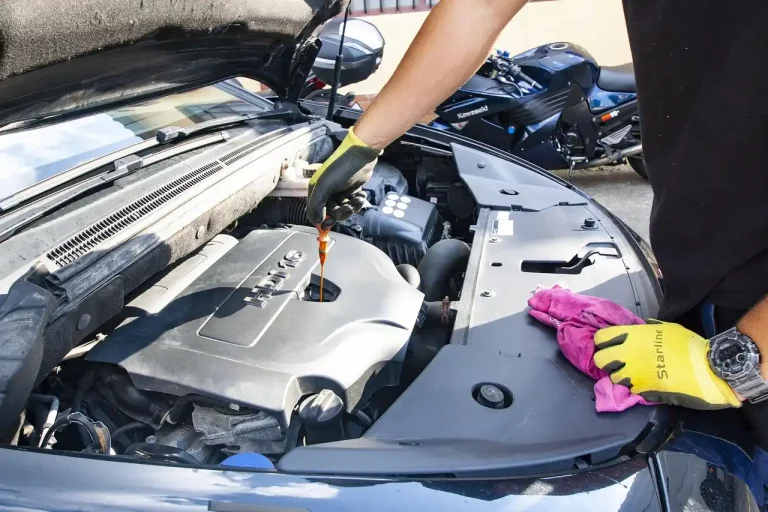
Hydraulic tensioners and cam control rely on suitable oil supply. Chain slack or adjuster behavior may be loudest before oil pressure stabilizes, which explains why cold-start rattle is often the first symptom owners notice.
Low oil level, poor oil condition, sludge, or delayed pressure buildup can mimic a worn chain or make a real chain problem appear sooner. A brief startup rattle on a stone-cold engine matters more than a vague noise heard after the engine has already warmed.
What are the symptoms of a bad timing chain in an SUV?
Common timing-chain symptoms include cold-start rattle, rough running, hard starting, loss of power, and correlation faults. Cold-start rattle, camshaft correlation faults, difficult starting and rough running can suggest timing trouble, but the pattern and progression matter more than any single sign by itself.
Cold-start rattle and what it usually means
The classic early symptom is a brief metallic rattle for a few seconds just after startup when the engine is stone cold. That often points to chain slack, a weak hydraulic tensioner, guide wear, or delayed oil pressure.
What it usually does not prove is that the chain alone is worn out. Accessory drive components, VVT phasers, and low oil pressure can sound similar, especially if the recording starts late or the hood is already open with engine noise echoing around the bay.
Picture a used midsize SUV that rattles for two seconds after an overnight sit, then idles smoothly all day with no codes. That is still an inspection item, but it is a different risk level from an SUV that rattles for eight seconds, stores repeated P0016-family faults, and cranks longer every week.
Rough idle, hard starting, and loss of performance
As cam timing drifts farther from the crank signal, idle quality can turn uneven, throttle response can soften, and the engine can feel flat under load. Long crank time can show up before a no-start, especially on engines where cam timing has moved beyond what the ECU can correct.
Some owners mistake this for spark-plug, coil, or fuel-system trouble. Those faults are real possibilities, which is why scan data, freeze-frame details, and engine-family history matter before approving chain work.
Warning lights, correlation codes, and no-start conditions
A check-engine light with P0016-type correlation faults raises the priority, but it still does not prove the chain itself is bad. Sensor errors, VVT issues, oil control problems, and incorrect previous repairs can also set similar faults.
The useful question is whether the code repeats under the same conditions and whether scan data shows timing control reaching its limit. A diagnostic scanner should guide testing, not replace mechanical inspection.
How symptoms usually progress if the problem is ignored
Chain problems usually develop in a pattern. First comes brief cold-start noise. Then the rattle lasts longer or shows up more often. Next come rough idle, hard starting, correlation codes, and drivability faults. The final stage is a jumped chain, stall, or no-start.
Metal debris in the oil or oil filter raises concern because it may indicate guide wear or other internal damage. At that point, continued driving becomes harder to justify.
How long does an SUV timing chain usually last?
Most SUV timing chains often last about 150,000 to 250,000 miles when oil quality, oil-change intervals, and tensioner health stay in range, but lifespan varies heavily by engine family. A well-maintained chain can outlast the vehicle; a neglected one can show symptoms much earlier because lubrication and guide wear drive the result.
Mileage bands by maintenance quality
A practical way to think about lifespan is by maintenance scenario, not by one universal replacement point.
- Well-documented oil service: many chain systems remain quiet deep into the 150,000 to 250,000 miles band.
- Average history with some gaps: first symptoms often appear earlier, especially at cold start.
- Neglected oil service or sludge history: tensioner and guide trouble can start far sooner than buyers expect.
Audi owners shopping higher-mileage examples should also note that at higher mileage, use the Audi 120,000 KM high-mileage service checklist. That does not replace engine-specific diagnosis, but it is a useful threshold for closer review on affected engines.
Why some chains outlast the vehicle and others do not
Chain design matters. So do guide material, tensioner design, chain length, oiling path, and whether the engine asks the chain to drive multiple camshafts and variable timing hardware.
Badge names hide these differences. Audi model badges span engines with different timing systems and component locations. The same basic point applies across many brands: one SUV name can include chain engines, belt engines, and multiple chain designs over its production run.
The role of oil-change intervals, sludge, and delayed oil pressure
Oil quality strongly affects hydraulic tensioners. Thick sludge, long drain intervals, wrong viscosity, low oil level, or delayed pressure buildup can let the chain run loose during startup and wear guides faster.
Say your prospective SUV has full dealer stamps for the first 60,000 miles, then no records for the next 70,000 miles and a startup rattle after sitting overnight. That gap matters more than a clean exterior or a recent battery, because lubrication history is part of timing-system risk.
Timing chain decision table
How to read the engine-family risk columns
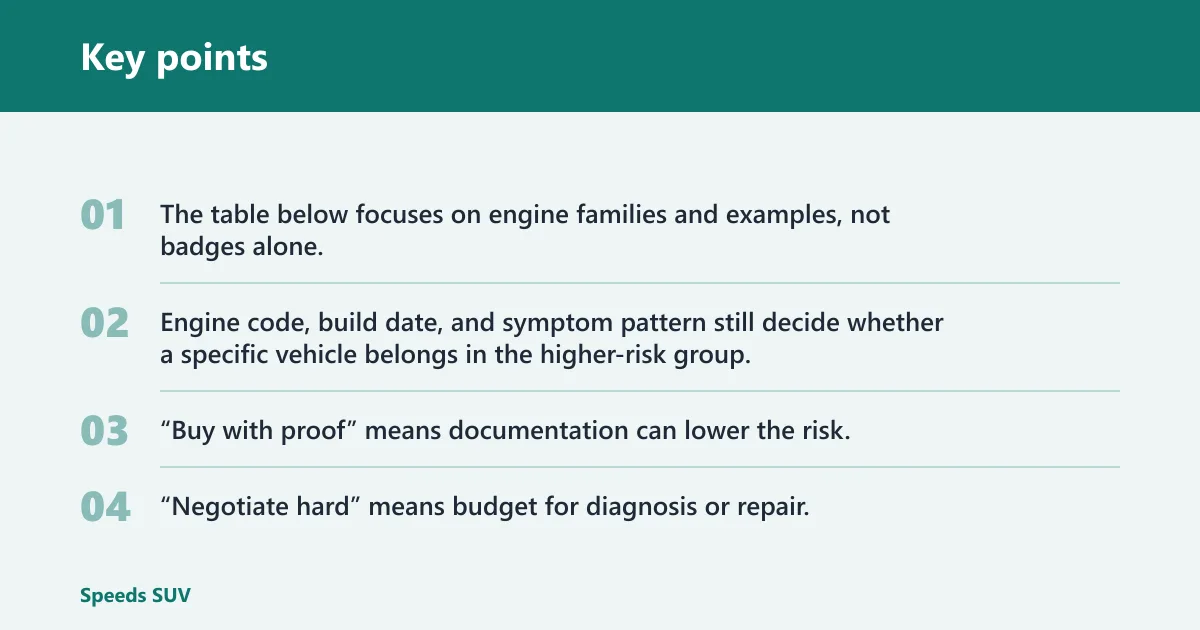
The table below focuses on engine families and examples, not badges alone. The lifespan band is a practical shopper range, the first-symptom column tells you what usually appears earliest, and the buy/no-buy column assumes no proof of recent timing-system service.
Read the examples narrowly, not broadly. A risk note for an engine family means some applications, years, or revisions deserve closer review; it does not mean every SUV wearing that badge has the same failure pattern. Engine code, build date, and symptom pattern still decide whether a specific vehicle belongs in the higher-risk group.
How to use the buy or no-buy and inspection-priority ratings
“Buy with proof” means documentation can lower the risk. “Negotiate hard” means budget for diagnosis or repair. “Walk away” means the symptom pattern already suggests drift or internal wear serious enough that the purchase only makes sense at an engine-project price.
Use the ratings as a triage tool. “Very high” priority means the engine family is one many shoppers examine closely on affected applications or when the usual symptoms appear. It does not mean every example is defective, and “medium” does not mean a noisy SUV should be dismissed as normal.
| Engine family / SUV examples | Typical lifespan range | First symptoms | Common false positives | Buy/no-buy risk | Inspection priority |
|---|---|---|---|---|---|
| GM 2.4L Ecotec I4 / Chevrolet Equinox, GMC Terrain | Often shorter if oil service was poor; many shoppers treat 100,000-150,000 miles as a high-attention band | Cold-start rattle, cam/crank correlation faults, rough idle | VVT actuator issues, low oil level, sensor faults | Negotiate hard without records; walk away if rattle plus repeated correlation codes | Very high |
| Ford 3.5L / 3.7L Duratec transverse applications / Explorer, Flex-based crossovers | Can run long with good oil service; risk rises with high mileage and neglected oil changes | Startup rattle, timing-related codes, rough running | Accessory tensioner noise, phaser noise, ignition faults | Buy with proof; negotiate if startup rattle is documented | High |
| VW/Audi 2.0T EA888 early generations / Q5, Tiguan | Wide spread; many buyers treat 80,000-140,000 miles as the key review band on suspect years | Cold-start rattle, correlation faults, extended crank | High-pressure fuel pump noise, accessory noise, cam adjuster issues | Buy with verified updated parts or clear records; otherwise negotiate hard | Very high |
| Audi 3.2 FSI V6 / Q5, Q7 | Often serviceable into higher mileage, but labor is expensive when issues appear | Rattle at startup, timing faults, rough idle | Intake runner faults, sensor faults, VVT control issues | Buy only with clean cold start and scan data; avoid if faults repeat | High |
| BMW N20 turbo I4 / X1, X3, X4 | Risk concentration often discussed before 100,000-120,000 miles on earlier examples | Whine or rattle, oil debris, correlation faults | Accessory bearing noise, turbo-related sounds, sensor faults | Walk away if guide debris or repeated timing codes are present; buy with proof only | Very high |
| BMW N63 V8 / X5, X6 | Varies sharply with maintenance and heat history; labor cost is high | Rattle, misfires, correlation faults | Injector or coil issues, valvetrain noise, low oil pressure | Negotiate only if specialist inspection is clean; otherwise walk away | Very high |
| Nissan 3.5L VQ V6 / Murano, Pathfinder | Often long-lived; tensioner or guide noise can still appear at high mileage | Startup rattle, occasional correlation fault | Belt-drive noise, exhaust shield rattle, cam sensor faults | Usually buyable with clean scan data and records | Medium |
| Toyota 2GR / 1GR chain V6 families / Highlander, 4Runner | Often reaches high mileage with regular oil service | Less commonly chain-led; startup noise needs careful source tracing | Accessory noise, VVT gear noise, normal startup sounds | Buy if inspection stays clean; do not assume chain trouble from noise alone | Medium |
Which SUV models are known for timing chain issues?
The highest timing-chain risk usually tracks with specific engine families, not an SUV badge by itself. Used shoppers should pay closest attention to early VW/Audi EA888 2.0T, GM 2.4L Ecotec, BMW N20, and some high-labor V6 or V8 layouts where startup rattle, guide wear, or repeated correlation faults are known concerns.
Engine families with a track record of chain stretch or guide wear
Among common used SUVs, early EA888 2.0T applications, GM 2.4L Ecotec four-cylinders, and BMW N20 applications are the names that come up repeatedly in chain-risk discussions. The exact fix, though, still depends on engine code and mechanical evidence.
Some engines are more prone to chain elongation. Others are more likely to suffer guide wear or tensioner issues first. That difference matters because one SUV may need a full timing set while another needs diagnosis of oil pressure or cam control before parts replacement.
SUVs where tensioner design is the main weak point
On some engines, the tensioner is the weak link because it depends on oil pressure at startup. A weak tensioner may let the chain slap briefly before pressure rises, which is why cold-start recordings are so useful.
That symptom can appear long before the chain has stretched enough to cause major drivability problems.
Why model badge alone is not enough
Do not shop by badge only. Production date, engine code, VIN lookup, and parts-catalog confirmation matter because the same SUV line may switch engines, switch timing hardware, or even change component location across trims and years.
A generic threshold copied from another engine can be misleading. Cam adaptation data is engine-specific, and a scanner value that worries buyers on one engine may be normal on another.
Which SUVs use chains instead of belts?
Most modern SUVs use timing chains, but the important detail is the engine, not the badge. The supporting guide breaks down which SUV brands and engine families usually run chains, which trims or older versions still use belts, and how to confirm your exact setup by engine code or service data. That matters because a belt-drive SUV may need scheduled replacement around 100,000 km or more, and missing that service can lead to expensive engine damage.
If you are shopping used or trying to plan maintenance, this timing chain guide helps you verify what is actually under the hood before you buy or budget for repairs.
How do you tell a real timing-chain problem from a false positive?
A real timing-chain problem usually shows a consistent pattern: stone-cold rattle, repeated codes, timing-control limits, or mechanical misalignment. False positives often come from accessory noise, VVT faults, sensor errors, or low oil pressure. The difference is found by matching sound, scan data, oil condition, and engine-specific verification.
Accessory noise versus cold-start chain rattle
Accessory noise often changes with belt load, steering input, or A/C engagement. Timing-chain rattle usually comes from the front or rear timing cover area and appears right after a true cold start, then fades as oil pressure stabilizes.
A common first-timer mistake is listening to a video taken after the seller moved the SUV to the driveway. That misses the most useful moment, because startup chain noise may last only a few seconds.
Sensor faults, VVT faults, and correlation codes
P0016-type codes matter, but they are support evidence, not proof. A bad cam sensor, wiring fault, sticky phaser, or oil-control problem can create similar code patterns.
Freeze-frame data helps. If the same fault returns under similar conditions after clearing, timing drift becomes more plausible. If it never comes back, code history alone is weak grounds for chain replacement.
Low oil pressure, poor oil condition, and startup noise
Because hydraulic tensioners depend on oil supply, oil level and service history are part of timing diagnosis. Dark oil does not prove a chain problem, but a low level, sludge signs, or an overdue service history raise the odds that startup rattle has a lubrication cause.
When needed, actual oil-pressure testing can separate a weak tensioner from a broader lubrication issue.
When mechanical timing verification is justified
Mechanical timing verification is the confirmation step when symptoms and scan data align. Depending on engine design, that may mean locking tools, cover removal, inspection of guide wear, or direct checking of chain alignment marks.
It is more reliable than code-only diagnosis. That matters most before approving a large estimate or buying a higher-risk used SUV.
A compact diagnostic hierarchy keeps false positives in order:
- Start with a true cold-start video. Capture the engine from before key-on through the first 10-15 seconds.
- Read stored, pending, and history codes. Correlation faults matter more when they repeat under similar conditions.
- Check live timing data. Cam adaptation or learned offset values can show whether control is nearing its limit on that engine.
- Test oil pressure when the pattern is unclear. Low pressure can mimic or worsen a timing complaint.
- Verify mechanical timing last. Use engine-specific procedures to confirm alignment before approving major parts replacement.
How do you diagnose timing-chain risk before buying a used SUV?
Before buying, the best timing-chain check combines a true cold-start video, stored and pending scan codes, service records, oil-condition review, and engine-code verification. That process separates a harmless rumor from a real chain-risk SUV and gives a solid basis to buy, negotiate, budget, or walk away.
Used-SUV inspection checklist
| Ask for | What to verify | Why it matters |
|---|---|---|
| Cold-start video | Engine fully cold, camera on before key-on, first 10-15 seconds captured | Startup rattle may only appear before oil pressure stabilizes |
| Scan codes | Stored, pending, and history codes plus freeze-frame data | Repeated correlation faults carry more weight than old cleared codes |
| Oil-change proof | Receipts, intervals, oil grade, mileage consistency | Oil quality and interval history strongly affect chain, guides, and hydraulic tensioners |
| Timing-system verification by engine code | Exact engine code, VIN, build date, and parts-catalog confirmation | Model badge alone is not enough to identify belt versus chain or exact hardware |
Buying procedure
- Verify the engine code. Match the VIN, build date, and engine code before discussing timing parts or risk. The same badge can hide different timing systems, and engine code and mechanical evidence determine the repair.
- Demand a cold start. Ask for a video or attend in person after the SUV has sat overnight. Listen from key-on through the first 10-15 seconds, because chain slack or adjuster behavior may be most audible before oil pressure stabilizes.
- Scan before the test drive. Check stored and pending codes, then review freeze-frame data. Correlation faults such as P0016 families should push the inspection higher on the priority list, especially if they repeat after clearing.
- Review service proof. Look for consistent oil-change records and the correct oil specification where known. Gaps, sludge signs, or unexplained low oil increase risk because hydraulic tensioners and cam control rely on suitable oil supply.
- Check live timing data. On supported engines, review cam adaptation or learned offset values using the correct measuring blocks or factory-style data list. A generic threshold copied from another engine can be misleading, so engine-specific limits matter.
- Decide on verification. If the SUV has cold-start rattle, repeated timing codes, or suspect adaptation data, require mechanical timing verification before purchase or price it as a pending repair. Code-only diagnosis is not enough for a confident buy decision.
Suppose a seller offers a compact luxury SUV at a strong price, but the scanner shows one old P0016 code and no service records for the last 40,000 miles. That is a negotiation case only if a true cold start stays clean and the engine family is verified by code. If startup rattle is added to that picture, risk rises fast.
Can you drive an SUV with a noisy timing chain?
Driving with a noisy timing chain is only remotely defensible when the noise is brief, unexplained, and awaiting prompt inspection. If the rattle repeats, lasts longer, or appears with correlation faults, hard starting, or metal debris, continued driving risks a jumped chain, stall, no-start, or internal engine damage.
When brief startup noise may still need urgent inspection
A short cold-start rattle can still be an early warning. It may be safe enough to move the SUV for diagnosis, but it should not be ignored for weeks because startup noise often appears before larger timing drift shows up.
When repeated rattle or correlation faults mean stop driving
If the rattle is getting louder, lasting longer, or accompanied by repeated P0016-family codes, rough idle, or hard starting, the safer call is to stop regular driving until the timing system is checked. The same applies if the oil filter shows plastic or metallic debris.
What chain failure can do to the engine
A failed chain can throw cam timing out of sync with the crankshaft. That can cause a sudden stall, a no-start, and on many engines, valve-to-piston contact that turns a timing repair into an engine replacement decision.
How much does SUV timing chain replacement cost?
SUV timing-chain cost varies more by engine layout and access than by parts price alone. Inspection is usually far cheaper than full replacement, while rear-chain layouts, multi-cam engines, and engines needing extensive teardown can push labor much higher than simple front-cover chain jobs.
Inspection and verification costs
Most shops charge diagnostic time first, often in the same range as other drivability or warning-light inspections. If the engine needs deeper mechanical timing verification, cost rises because covers, mounts, or specialty tools may be required.
That added inspection cost is often money well spent, because it avoids replacing parts on code alone.
Chain kit, tensioner, and guide replacement cost drivers
The parts list often includes the chain, tensioner, guides, seals, and sometimes cam phasers, oil-control parts, or related hardware. A partial repair can be cheaper, but many technicians prefer replacing the wear set together once access is open.
Price also changes if debris cleanup, oil-pump work, or damaged valves are involved.
Why labor differs so much between SUV engines
Front-mounted transverse four-cylinders are one thing. Rear-chain V6 or V8 layouts buried near the firewall are another. Packaging, not badge prestige, often decides the final bill.
For shoppers, the point is simple: the same level of startup noise can mean a very different ownership risk depending on engine family.
How do you confirm whether your SUV uses a timing chain or belt?
The only reliable way to confirm chain versus belt is to verify the exact engine code, VIN, build date, and parts-catalog listing. Model names are too broad. The same SUV line can switch engines across trims or years, and timing hardware can vary even when displacement looks similar.
Engine code and VIN lookup
Start with the VIN and engine code from the vehicle label, emissions sticker, or factory data source. Then match that to a parts catalog or factory information system before ordering parts or trusting internet advice.
Production-date and trim differences
Mid-cycle changes happen. A facelift year, new trim, or engine revision can change whether the engine uses a belt or chain, or move the timing hardware to a different service location.
Why parts-catalog confirmation matters before estimates
Repair estimates, symptom expectations, and labor time all depend on the exact engine. That is especially true on Audi and other brands where model badges span engines with different timing systems and component locations.
Frequently asked questions
What does a timing chain rattle sound like on cold start?
It usually sounds like a brief metallic clatter or chatter in the first seconds after startup, strongest when the engine is stone cold. It often fades as oil pressure builds. Belt-drive squeal and accessory-bearing noise can sound similar, so the recording must begin before key-on for a useful comparison.
What causes timing chain problems in SUVs?
Common causes include long oil intervals, sludge, low oil level, delayed oil pressure, worn guides, and weak hydraulic tensioners. Some engine families also have design-specific weak points. Poor lubrication matters because hydraulic tensioners and cam-control systems rely on oil supply to keep chain tension stable during startup and operation.
How do I tell if my SUV has a timing chain or a timing belt?
Use the VIN, exact engine code, build date, and a parts-catalog lookup. Do not rely on the badge or trim name alone. One SUV model can be sold with different engines, and timing hardware can change across years, so engine-code confirmation should come before diagnosis, estimates, or parts ordering.
What happens when a timing chain fails in an SUV?
If the chain jumps or breaks, valve timing is lost. The engine may stall, crank without starting, or run badly for a moment before shutting off. On interference engines, pistons can hit valves, turning a timing-system failure into major internal engine damage with much higher repair cost.
How long should an SUV timing chain last?
On a well-maintained engine, many chains stay serviceable for about 150,000 to 250,000 miles. That is a lifespan band, not a promised replacement interval. Poor oil service, sludge, low oil level, or a weak tensioner can shorten life substantially, while a well-kept engine may never need chain replacement at all.
Can low oil cause timing chain noise?
Yes. Low oil level, dirty oil, sludge, or delayed pressure buildup can reduce hydraulic tensioner performance and create startup rattle that resembles chain wear. It can also accelerate real wear. That is why oil level, service history, and sometimes oil-pressure testing belong early in diagnosis instead of after parts have been ordered.
Can a timing chain code be a false alarm?
Yes. Correlation faults can be triggered by cam or crank sensors, wiring issues, VVT control problems, oil-supply faults, or incorrect previous repairs. A repeated code plus cold-start rattle is more meaningful than an old stored code alone. The stronger path is sound, freeze-frame data, live timing data, and then mechanical verification.
Should I buy a used SUV with timing chain noise?
Usually only if the price clearly reflects the risk and the engine family has been verified. A brief unexplained startup noise might justify deeper inspection, but repeated cold-start rattle, recurring P0016-family faults, hard starting, or debris in the oil moves the SUV into negotiate-hard or walk-away territory for most buyers.