Payload Ratings Explained for Trucks and SUVs
Payload is the amount of weight your truck or SUV can carry, and the limit that matters is the door-jamb Tire and Loading sticker: people, cargo, accessories, and trailer tongue weight all come out of that single allowance. Ignore it and you can overload axles, tires, and suspension, reduce braking and handling, and end up outside the tow setup your vehicle is actually certified to carry. This guide shows how to find your exact payload, subtract every pound that counts, and compare trims or tow rigs without guessing.
The basic rule is simple: payload is a fixed allowance tied to the exact vehicle, not a brochure best case. A heavier trim, 4WD system, diesel engine, third row, larger wheels, bed cap, toolbox, hitch load, or family road-trip gear all pull from the same total. Trucks and SUVs use that allowance differently, and three-row SUVs can run short sooner than many owners expect.
What is a payload rating?
A payload rating is the maximum usable load your specific truck or SUV can carry before it reaches its certified loaded-weight limit. That one number has to cover passengers, child seats, pets, luggage, tools, aftermarket accessories, and trailer tongue weight, so the exact door-jamb sticker matters more than a generic brochure figure.
What counts against payload
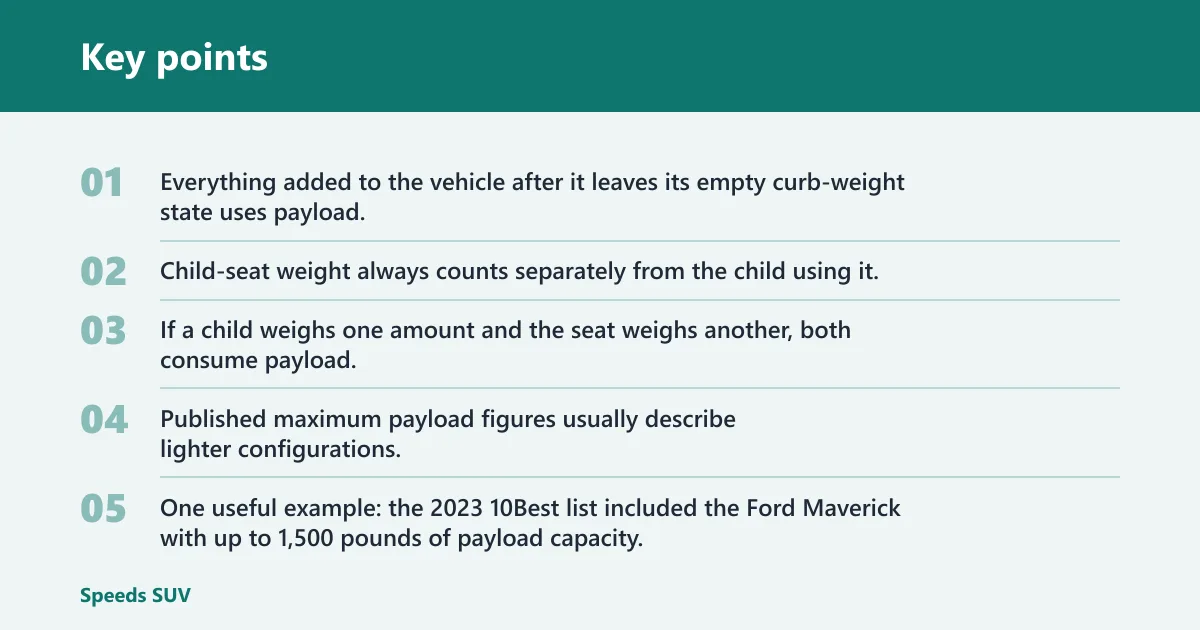
Everything added to the vehicle after it leaves its empty curb-weight state uses payload. That includes the driver, every passenger, every child seat, cargo in the cabin or cargo area, cargo in the bed, hitch hardware, trailer tongue weight, and installed equipment such as bed caps, racks, drawers, winches, tanks, shelving, and liftgates.
Child-seat weight always counts separately from the child using it. If a child weighs one amount and the seat weighs another, both consume payload.
Fuel is generally already accounted for in the label convention owners see on the vehicle, but the safe move is still to trust the specific label and owner’s manual for that exact model rather than a broad brochure claim.
Why the sticker number beats brochure claims
Published maximum payload figures usually describe lighter configurations. They do not automatically apply to a crew cab, luxury trim, 4WD model, diesel, larger wheel package, or heavily optioned SUV.
One useful example: the 2023 10Best list included the Ford Maverick with up to 1,500 pounds of payload capacity. That “up to” figure is real for a qualifying configuration, but an owner still needs the payload label on the exact truck in the driveway before loading people, tools, or hitch weight.
The same split appears with towing. The Ford Maverick hybrid was rated to tow 2,000 pounds, while the Ford Maverick turbo 2.0-liter could tow 4,000 pounds. Different powertrains change capabilities, and payload changes with configuration too.
Why payload changes by trim and configuration
Payload varies because GVWR stays fixed for a given certification, while the vehicle’s empty weight changes with hardware. Add mass to the truck or SUV itself and there is less left for people and cargo.
Common payload reducers include 4WD hardware, heavier engines and cooling systems, larger cabs, third-row seating, luxury features, bigger wheels and tires, and factory towing or off-road packages. Dealer-installed accessories added after the factory label also consume payload even though the sticker number does not change.
Payload, GVWR, curb weight, and axle ratings
How GVWR sets the loaded-vehicle ceiling
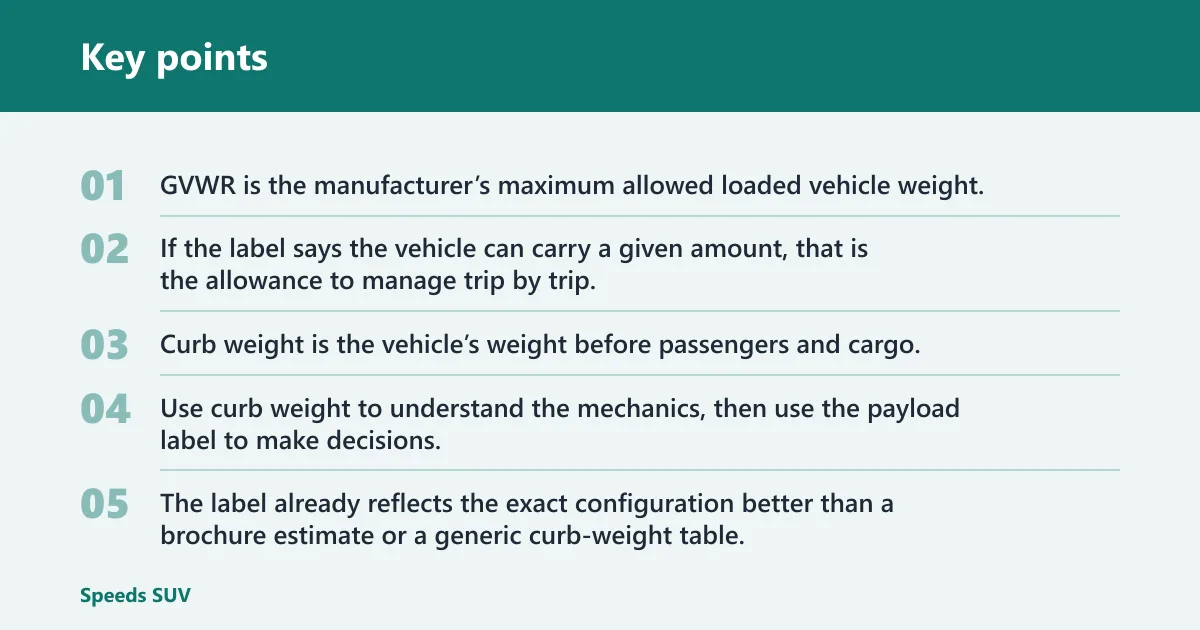
GVWR is the manufacturer’s maximum allowed loaded vehicle weight. Payload is the part of that limit left after the vehicle’s own empty weight is accounted for, which is why the door-jamb payload label is the best vehicle-specific shortcut for owners.
The relationship is direct: curb weight plus people, gear, accessories, and tongue weight cannot push the vehicle above GVWR. Payload is the usable share of that total. If the label says the vehicle can carry a given amount, that is the allowance to manage trip by trip.
Where curb weight fits into the math
Curb weight is the vehicle’s weight before passengers and cargo. It helps explain why heavier trims have less remaining payload, but curb weight alone is still not the number to load by.
Use curb weight to understand the mechanics, then use the payload label to make decisions. The label already reflects the exact configuration better than a brochure estimate or a generic curb-weight table.
Why front and rear axle limits can be the first limit you hit
Each axle has its own rating, usually shown as front and rear GAWR on the certification label. A truck or SUV can stay under total GVWR and still overload one axle, especially the rear axle when towing or carrying a concentrated load behind the cabin.
Bed cargo stacked near the tailgate, a heavy tongue load, a drawer system, or a fully occupied third row can shift too much weight rearward. Front axle overload can happen too with front-mounted accessories such as heavy bumpers or winches, depending on the model.
Why tire load rating still matters
The tires must be able to support the actual load carried on each axle. Combined tire capacity and the vehicle’s specified tire information have to match the real axle loads shown by the loaded vehicle, and inflation affects how the tire can carry its rated load.
That does not mean more air fixes an overload. Tire pressure does not make an overloaded axle safe or compliant; if an axle or the whole vehicle is overloaded, weight must be removed or redistributed within the manufacturer’s limits. Follow the vehicle and tire manufacturer information for your model, never work under a vehicle held only by a jack, keep items out of airbag zones and the driver’s view, never exceed the vehicle’s rated roof, hitch, or tow limit, and check local laws.
How do you find your truck or SUV’s payload rating?
Check the driver’s door Tire and Loading label first. That sticker gives the vehicle-specific carrying capacity for that exact truck or SUV, while nearby certification labels list GVWR and front and rear axle ratings that you also need when loads are concentrated or a trailer is attached.
Door-jamb labels to read
Look for the Tire and Loading label on the driver’s door or door jamb. It typically states that the combined weight of occupants and cargo should never exceed a specific amount.
Nearby, the certification label lists GVWR and the front and rear GAWR values. Those are separate ratings. Do not confuse the payload figure with GVWR; one is the load allowance, the other is the total loaded-vehicle ceiling.
How to separate payload from GVWR and GAWR
The quickest reading order is this: payload label first, GVWR second, axle ratings third. Payload tells you what can be added. GVWR tells you the total loaded limit. GAWR tells you whether a front-heavy or rear-heavy load can exceed one axle before the whole vehicle reaches its overall maximum.
Say your SUV has a generous-looking cargo area, a third row full of passengers, and luggage stacked behind that row. The total added weight may still fit within the raw payload number, but the rear axle can become the first limit you hit because the load sits so far back.
When the owner’s manual and manufacturer listing matter
Use the manual and manufacturer listing when the labels leave a question about approved hitch setups, weight-distribution equipment, seating positions, roof-load rules, tire specifications, or accessory fitment. For post-sale accessories and upfits, check the manufacturer’s listing for your model because the added hardware reduces real payload even though the sticker stays the same.
Why is your payload lower than expected?
Payload usually comes in lower than expected because buyers compare their own truck or SUV with a stripped brochure maximum. Heavier drivetrains, larger cabs, third rows, luxury trims, bigger wheels, factory packages, and added accessories all raise empty weight and cut the carrying capacity left on the label.
4WD, diesel, and heavier powertrains
Extra hardware costs payload. A 4WD system adds components. A heavier engine or diesel package can do the same, along with cooling and drivetrain parts sized for that setup.
This is one reason towing and payload should never be treated as the same thing. Ram HD models include the 2500 and 3500 heavy-duty pickups, and Ram heavy-duty trucks can tow more than 35,000 pounds when properly equipped. A very high tow rating does not mean every trim has abundant payload left for passengers, hitch load, and bed gear.
Crew cabs, third rows, luxury trims, and larger wheels
More seats, more structure, more sound insulation, powered features, larger wheels, and heavier tires all add weight before you load a single bag. Trucks often lose payload when moving from a lighter regular-cab work spec to a loaded crew cab. SUVs often lose it when adding a third row or upscale trim equipment.
Picture a three-row SUV heading to the airport with six people, two child seats, and luggage for a week. The vehicle may run short on remaining payload long before the cargo area looks full, because people and seats are spending the allowance first.
Accessories, upfits, and dealer-installed equipment
Accessories count whether they were fitted at the factory, at the dealer, or later in the vehicle’s life. Bed covers, caps, racks, toolboxes, larger bumpers, drawer systems, fuel tanks, shelving, liftgates, and service bodies all eat into payload.
The key distinction is timing. The sticker does not update after a dealer installs accessories, but the real remaining payload still drops because the vehicle is now heavier than it was when certified.
What uses up payload in the real world?
Real payload disappears through ordinary additions: adults, kids, child seats, pets, coolers, travel bags, tools, bed accessories, hitch hardware, and trailer tongue weight. The fastest way to avoid mistakes is to treat every added item as a debit against one fixed number from the label.
Passengers, child seats, pets, and travel gear
Passengers are often the biggest hidden expense because they are easy to overlook when owners focus on cargo or towing. In SUVs, second- and third-row occupants can consume most of the allowance before luggage goes in.
A common first-timer mistake is counting only “cargo” in the back and forgetting the family up front. Add the driver, every passenger, the dog crate, the stroller, and each child seat before thinking about rooftop boxes or trailer equipment.
Tongue weight and hitch hardware
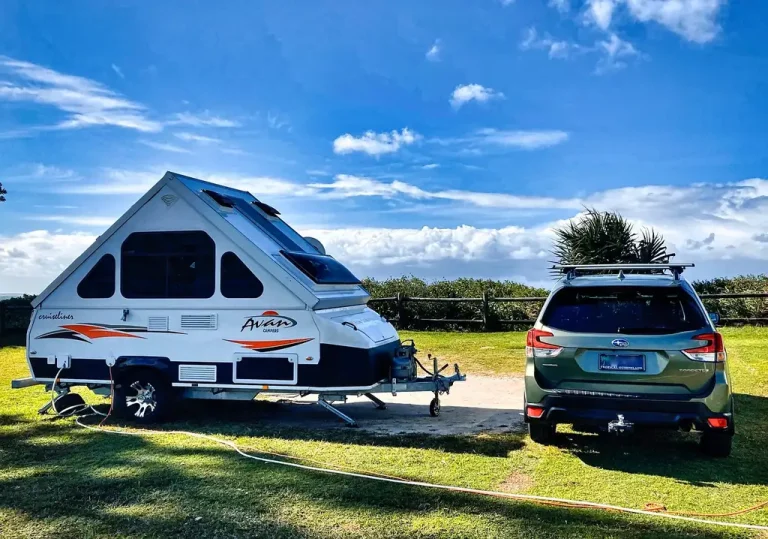
Tongue weight is the downward force the trailer applies to the hitch. It counts against payload just like a person or toolbox does, and so does any installed hitch hardware beyond what the vehicle already carries in its certified configuration.
Suppose a midsize truck is comfortably under its advertised tow rating, then gets loaded with four adults, a cooler, a bed organizer, and a trailer with substantial hitch load. The tow number may still look fine, but the truck can run out of payload or rear-axle capacity first.
Toolboxes, caps, racks, tanks, and drawer systems
Work-truck and overlanding builds often lose payload before owners notice. Toolboxes, bed caps, racks, recovery gear, water or fuel tanks, fridge slides, and drawer systems can push a light-duty truck much closer to its label than expected.
If the vehicle is part of a trade fleet, service body additions and liftgates deserve the same scrutiny. Those upfits increase empty weight every day, so the available payload for tools, materials, and crew shrinks every day too.
Payload budget worksheet
Trip worksheet example
| Certified payload | Driver | Passengers | Cargo | Hitch/tongue weight | Bed accessories | Remaining payload | GVWR result |
|---|---|---|---|---|---|---|---|
| 1,620 lb | 190 lb | 420 lb | 180 lb | 540 lb | 140 lb | 150 lb | Pass |
| 1,620 lb | 190 lb | 420 lb | 260 lb | 540 lb | 140 lb | 70 lb | Pass |
| 1,620 lb | 190 lb | 420 lb | 340 lb | 540 lb | 140 lb | -10 lb | Fail |
How to fill it out for a truck
- Start with the sticker. Copy the exact payload figure from the Tire and Loading label. Do not start with a brochure maximum, because trims and options change the certified number.
- Add every occupant. Count the driver and each passenger. If children ride along, count each child and each child seat as separate entries against payload.
- Add cargo and tools. Include coolers, luggage, jobsite tools, generators, recovery gear, and anything else carried in the cab or bed. If an item stays in the truck full time, it still counts on every trip.
- Add hitch load. Include trailer tongue weight and any hitch hardware that adds weight beyond the vehicle’s certified setup. A towing setup can be under tow rating and still fail on payload.
- Add fixed accessories. Count bed caps, toolboxes, drawer systems, racks, tanks, or other installed equipment. Subtract the total from certified payload to find remaining payload, then confirm with a scale ticket if the margin is tight.
How to fill it out for an SUV
- Use the same sticker method. The payload label works the same way on an SUV as on a pickup. The allowance is still one fixed total for people, cargo, and hitch load.
- Count all seating rows. Add front-, second-, and third-row occupants individually. Families often miss how quickly a full third row cuts remaining payload.
- Count every seat and carrier. Child seats, pet crates, strollers, cargo boxes carried inside, and rear cargo organizers all spend payload. Do not ignore seat hardware because the child’s body weight was already counted.
- Add trailer hitch load. If the SUV tows, count tongue weight against payload before adding vacation bags. Rear cargo plus hitch load can push the rear axle close to its limit fast.
- Check the result honestly. If the remaining figure is small, pack less, move to a lighter trailer setup, or choose a vehicle with a higher label. Follow the vehicle and product manuals, never exceed rated roof, hitch, or tow limits, keep items out of airbag zones and the driver’s view, and check local laws.
How do you verify remaining payload on a scale?
The best verification is a scale ticket with the vehicle loaded as it will actually travel. A single total weight tells you how close you are to GVWR, and separate front and rear axle weights show whether one axle is overloaded even when the total still looks acceptable.
Single weight versus separate axle weights
A single scale reading is useful, but separate axle readings are better because payload problems are often axle problems first. This matters with trailers, bed cargo, rear cargo behind the third row, and front-mounted accessories.
Use a scale when the worksheet leaves a small margin, when a trailer is involved, when the load is concentrated, or when the vehicle has several permanent accessories. A scale ticket gives a real answer instead of a guess.
Truck with trailer attached
- Load for the trip. Put the truck in travel condition with passengers, tools, accessories, fuel, and trailer attached as it will actually be used. That is the only way to capture real hitch load and axle distribution.
- Get a total weight. Use a public scale to record the loaded truck and trailer setup according to the scale’s procedure. Keep the ticket so the numbers can be compared with GVWR and axle ratings later.
- Get axle weights. If the scale can provide separate front and rear axle readings, use them. Rear-axle overload is common with tongue weight and bed cargo, even when the overall combination feels stable enough at low speed.
- Compare with labels. Match the ticket to GVWR and GAWR on the certification label. If any limit is exceeded, remove or redistribute weight within manufacturer limits; tire pressure does not make an overload safe or compliant.
SUV with passengers and cargo
- Seat everyone first. Load the SUV with the same passengers, child seats, pets, and cargo planned for the trip. A family travel setup can change axle balance more than owners expect.
- Weigh with accessories installed. Leave roof crossbars, cargo organizers, hitch carriers, and other add-ons in place if they will travel with the vehicle. They are part of the real empty-to-loaded calculation.
- Check rear-axle margin. Ask for separate axle readings where possible. Third-row occupants and luggage behind them can consume rear-axle capacity faster than the overall payload figure suggests.
Truck and SUV loading checklists
Practical loading steps
- Read the label. Start every trip or build with the door-jamb payload figure, then note GVWR and front and rear axle ratings nearby. That keeps the exact vehicle, not an online spec page, at the center of the decision.
- List permanent add-ons. Write down the accessories that live on the vehicle full time, such as a cap, rack, toolbox, drawers, bumper, winch, shelving, or liftgate. These reduce available payload before people or cargo are added.
- Count every person and seat. Add the driver, passengers, and the weight of each child seat. For SUVs, include all occupied rows; for trucks, include everyone in the cab before loading the bed.
- Add trip cargo. Include bags, coolers, pet crates, tools, generators, and loose gear in the cabin, cargo area, or bed. If towing, add hitch hardware and trailer tongue weight here too.
- Watch load placement. Keep in mind that concentrated rear loads can exceed rear-axle limits before GVWR is reached. Spread cargo according to the owner’s manual and keep heavy items secured and low.
- Verify on a scale. If the worksheet leaves a narrow margin, get a scale ticket with separate axle weights if available. Follow the vehicle and product manuals, never exceed rated roof, hitch, or tow limits, never work under a vehicle held only by a jack, keep items out of airbag zones and the driver’s view, and check local laws.
What happens if you overload payload?
Overloading payload reduces braking and stability margin, can overload axles and tires, can increase suspension sag, and can change headlight aim and steering feel. The real fix is removing or redistributing weight within the manufacturer’s limits, because an overloaded vehicle is still overloaded even if it seems to drive normally at first.
Handling, braking, and suspension effects
Too much weight makes the vehicle work harder in every basic control task. Braking distances can grow, body motions can get slower and heavier, and rear sag can unload the front end enough to affect steering precision and headlight aim.
Those effects can show up before the driver sees anything dramatic. A truck that looks only slightly nose-high or tail-low can already be beyond the intended operating range for suspension and braking balance.
Axle and tire overload risks
Axles and tires care about the load actually sitting on them, not just the total on paper. A trailer hitch, a bed full of material near the tailgate, or luggage stacked behind a third row can overload the rear axle and rear tires first.
That is why a scale ticket with axle weights matters. If the axle or tire load is over the vehicle or tire manufacturer limit for that model, weight has to come off or move to a different approved setup.
Why removing weight is the only real fix
There is no shortcut for an overloaded vehicle. Higher tire pressure does not legalize or normalize an overloaded axle, helper springs do not increase the certified rating, and a stable-feeling test drive does not rewrite the label.
The only dependable response is to remove weight, move weight within approved limits, reduce trailer tongue load by correcting the trailer’s loading within manufacturer guidance, or step up to a vehicle with a higher real payload label.
Frequently asked questions
Does payload include passengers and fuel?
Passengers count against payload, and so do child seats, pets, cargo, accessories, and trailer tongue weight. Fuel is generally already accounted for in the label convention owners see on the vehicle, but owners should still rely on the specific door-jamb label and owner’s manual for their exact model.
What is the difference between payload and GVWR?
Payload is the amount you can add to the vehicle. GVWR is the maximum the whole vehicle is allowed to weigh when loaded. Think of GVWR as the ceiling and payload as the remaining allowance under that ceiling for people, cargo, accessories, and hitch load.
How much payload do I lose with towing tongue weight?
You lose payload pound for pound with trailer tongue weight because that downward hitch force is part of what the vehicle carries. The exact tongue load varies by trailer and loading, so confirm the trailer and hitch guidance for your model and verify the setup on a scale.
Do accessories count against payload?
Yes. Bed caps, covers, racks, toolboxes, winches, heavier bumpers, shelving, tanks, drawer systems, and other add-ons all reduce remaining payload. That is true whether they were factory installed, dealer installed, or added later, even though the original sticker number on the door jamb does not change.
Why is my truck’s payload lower than I expected?
Most disappointments come from comparing a real truck with a lighter advertised maximum configuration. Crew cabs, 4WD, heavier engines, luxury trims, larger wheels, towing packages, and accessories all add weight to the truck itself, leaving less certified capacity available for passengers, bed cargo, and hitch load.
What happens if I overload my truck payload
An overloaded truck can lose braking and handling margin, sag in the rear, aim its headlights poorly, and exceed axle or tire limits even if the total GVWR number looks close. The answer is to remove or redistribute weight within manufacturer limits and confirm the loaded setup with a scale ticket.