What Does SUV Towing Capacity Actually Mean?
SUV towing capacity is the maximum trailer weight the vehicle can legally and mechanically pull as specified by the manufacturer, but the usable limit drops once you add passengers, cargo, and tongue weight. Ignore those limits and you can overheat brakes, overload tires, and exceed the vehicle’s rated gross combined weight, which can lead to instability and expensive damage. This guide explains how towing capacity, payload, tongue weight, and trailer brakes work together so you can judge what your SUV can actually tow.
Towing limits and vehicle weight ratings
Towing capacity is the vehicle’s maximum gross pulling weight behind it. It changes with engine, trim, drivetrain, axle ratio, cooling package, and other equipment, so two SUVs with the same badge can have different ratings. The brochure number is only the starting point.
Maximum pull rating
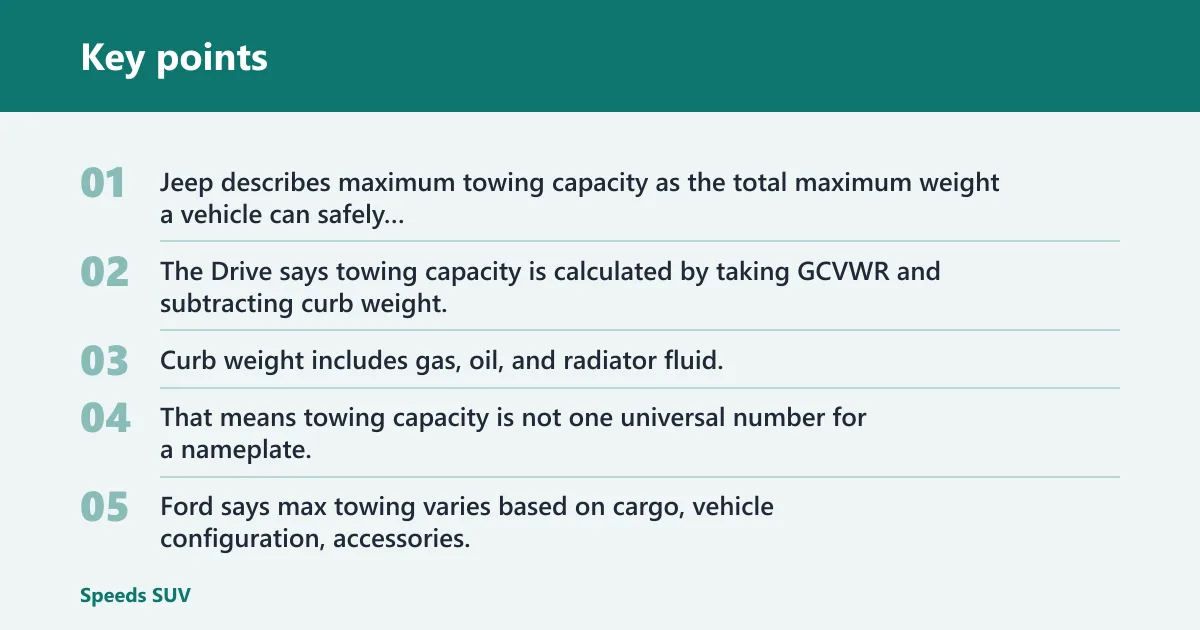
Jeep describes maximum towing capacity as the total maximum weight a vehicle can safely tow. The Drive says towing capacity is calculated by taking GCVWR and subtracting curb weight. Curb weight includes gas, oil, and radiator fluid.
That means towing capacity is not one universal number for a nameplate. Ford says max towing varies based on cargo, vehicle configuration, accessories, and number of passengers. Ford’s SUV and car towing section includes Explorer, Expedition, Bronco, Bronco Sport, Escape, and Mustang.
How it differs from payload and curb weight
Payload is what the SUV can carry on board. Curb weight is the SUV itself with fuel and necessary fluids, but without passengers or cargo. GVWR stands for gross vehicle weight rating, which is the loaded weight limit for the SUV itself. Towing capacity is a separate pull limit, and you need both limits to fit at the same time.
Say your SUV has a healthy tow rating but a full cabin: two adults, three kids, a cooler, luggage, and a hitch-mounted cargo basket. The tow number may still look fine on paper, but the added load can push the SUV toward GVWR before the trailer weight does.
Braked vs unbraked towing
Braked towing capacity applies when the trailer includes brakes of its own, and unbraked towing capacity applies when it does not. Braked ratings are usually higher because the trailer helps stop itself. Unbraked ratings are lower, and on smaller trailers they are often around 750 kg, depending on the vehicle and market.
What a braked trailer changes
A braked trailer reduces the work the SUV must do during stopping. That is why many vehicles list one number for braked towing and a lower one for unbraked towing. Loadmate says braked towing capacity is the maximum loaded trailer weight when the trailer has its own brakes.
Why unbraked limits are lower
The same source says unbraked towing capacity applies when the trailer does not have its own brakes. That lower figure is still a hard limit. If the trailer has no brakes, you cannot use the braked number just because the hitch can physically connect to the trailer.
Also check the tow hitch or towbar rating. The lowest stamped rating in the chain governs: vehicle, hitch, ball mount, and trailer must all be rated for the same job. If one part is lower, that part sets the limit.
How do GVWR and GCWR fit in?
GVWR is the maximum loaded weight of the SUV itself. GCWR, or GCVWR when a maker uses that wording, is the maximum allowable combined actual weight of the loaded tow vehicle and loaded trailer. Both matter because an SUV can be under its tow rating and still be too heavy once passengers, cargo, and trailer are all on board.
GVWR as the loaded SUV limit
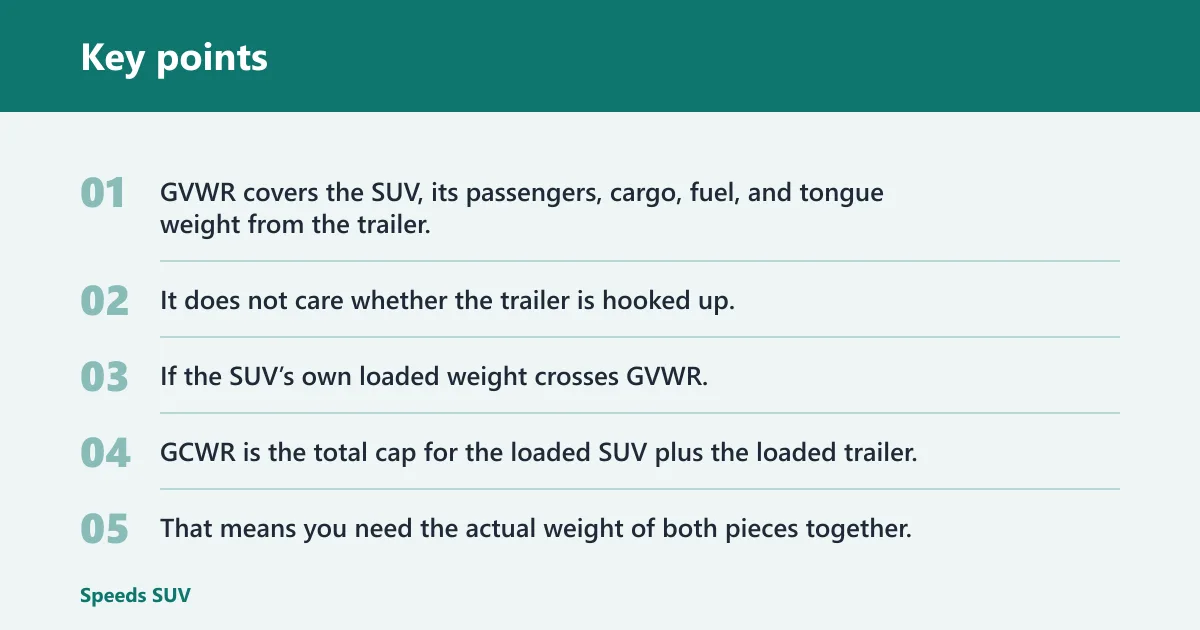
GVWR covers the SUV, its passengers, cargo, fuel, and tongue weight from the trailer. It does not care whether the trailer is hooked up. If the SUV’s own loaded weight crosses GVWR, the setup is out of spec even if the trailer itself is light.
GCWR/GCVWR as the combined limit
GCWR is the total cap for the loaded SUV plus the loaded trailer. That means you need the actual weight of both pieces together, not just the trailer’s advertised mass. Do not treat GCWR as trailer weight plus GVWR; it is a combined actual-weight limit.
Picture a midsize SUV with a family of five, a dog, and a cooler in the cargo area. The trailer might be well under the brochure tow number, but the combined weight can still run into GCWR once the SUV’s cabin load and the trailer’s real loaded weight are added together.
Why both matter in one tow calculation
A tow check must answer two questions at once: is the SUV itself under GVWR, and is the vehicle-plus-trailer combination under GCWR? If either answer is no, the setup is not a safe fit. That is why a single “can tow” number is not enough.
Does tongue weight reduce payload?
Yes. Tongue weight, or tow ball load, is the downward pressure of the trailer tongue on the hitch ball. It counts as part of the SUV’s load, so it uses payload capacity just like passengers and cargo. It is counted once, inside the vehicle load, not twice.
How it counts against the SUV
If the trailer places about 400 lb on the hitch, that load sits on the SUV’s rear axle and within the SUV’s GVWR. Jeep defines tongue weight as the downward pressure of the trailer tongue on the hitch ball. That load reduces the payload left for people and gear.
Why rear cargo can erase towing margin
Rear cargo often lands in the same zone as tongue weight: the back of the vehicle. Add a full cargo area, a hitch rack, and several passengers, and the payload margin can disappear fast even though the brochure tow figure still looks generous. That is one reason SUVs can feel tight sooner than pickups.
A common first-timer mistake is adding passengers and luggage first, then assuming the trailer weight can stay at the brochure maximum. The correct order is the reverse: count the SUV’s load first, then see what towing margin remains.
Tow ratings worksheet
Use this worksheet before you hitch the trailer. It is a plain-text check, not a substitute for the owner’s manual or the vehicle-specific towing guide.
| Input | Example value | Why it matters |
|---|---|---|
| Vehicle towing rating | 5,000 lb braked | Highest trailer weight the SUV is rated to pull |
| Passenger/cargo weight | 1,100 lb | Counts toward GVWR and reduces payload |
| Estimated tongue weight | 450 lb | Counts toward the SUV’s load, so it uses payload |
| Trailer type | Braked | Uses the braked rating, not the unbraked rating |
| Output | No safe-use margin | Likely limit first: payload or GVWR, before the tow rating |
Plain-text check: If the SUV’s remaining payload is less than 1,550 lb, this example fails before you even get to trailer weight. That 1,550 lb figure is based on about 1,100 lb of passengers and cargo plus about 450 lb of tongue weight. If the vehicle’s GCWR margin is also tight, the combined limit may bind next.
- Write down the vehicle’s braked or unbraked towing rating from the towing guide.
- Add all passengers, cargo, and any hitch-mounted load that sits on the SUV.
- Estimate tongue weight from the trailer’s loaded weight and check that it fits inside payload.
- Compare the SUV’s actual loaded weight plus trailer weight to GCWR or GCVWR.
- Check the hitch, towbar, ball mount, and trailer brake rating, then use the lowest rating.
Can your SUV tow safely?
Start with the vehicle-specific towing guide, then compare the SUV’s ratings with the trailer’s loaded weight, brake setup, hitch rating, and cabin load. If the SUV is near GVWR, if the hitch rating is lower than the trailer, or if the trailer lacks brakes where brakes are required, the setup needs rework.
Check the vehicle-specific towing guide
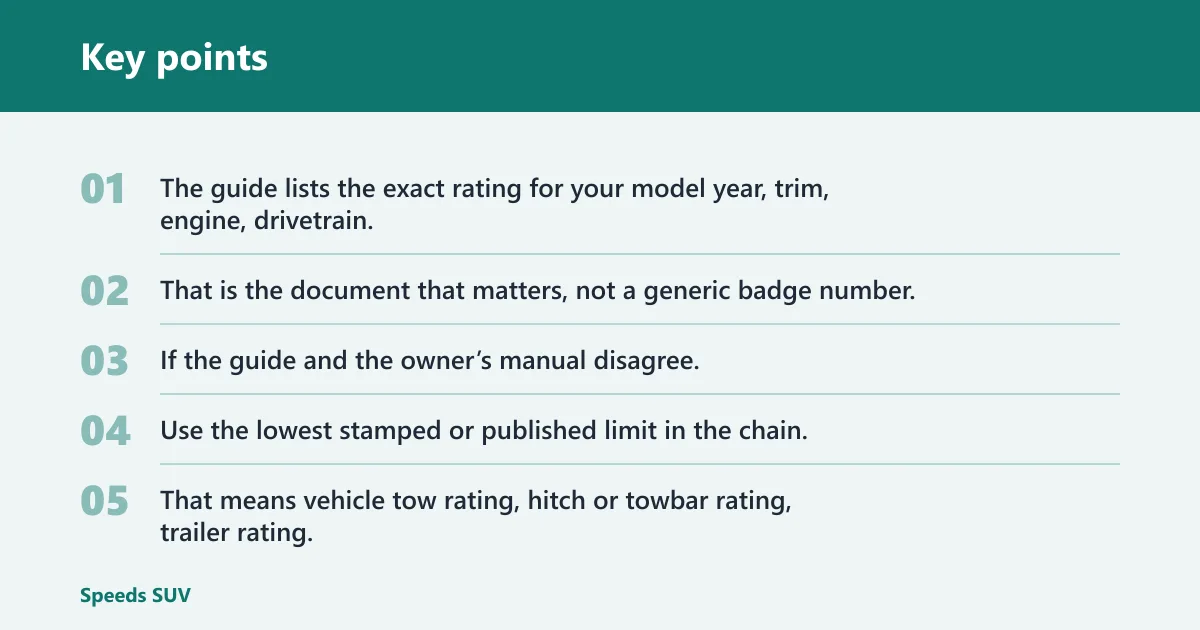
The guide lists the exact rating for your model year, trim, engine, drivetrain, and installed equipment. That is the document that matters, not a generic badge number. If the guide and the owner’s manual disagree, follow the manufacturer’s listing for your exact vehicle.
Compare hitch, trailer, and vehicle ratings
Use the lowest stamped or published limit in the chain. That means vehicle tow rating, hitch or towbar rating, trailer rating, and brake setup all need to line up. If the trailer is braked, use the braked number. If it is unbraked, use the unbraked number.
Read the result as a margin, not a guess
The same source says many manufacturers urge using no more than 80% of maximum towing capacity. That is a margin, not a law, but it is a useful buffer when the SUV is full of people or gear. A setup that technically fits on paper can still feel strained on grades, in crosswinds, or during hard stops.
Follow the vehicle and trailer manuals, never work under a vehicle held only by a jack, never exceed the vehicle’s rated roof, hitch, or tow limit, keep items out of airbag zones and the driver’s view, and check local laws.
Frequently asked questions
What does car towing capacity mean?
Car towing capacity is the maximum trailer weight the vehicle is rated to pull. For SUVs, that number depends on the exact trim and equipment. It is a pull limit, not a permission slip to load the cabin to the brim and still use the full brochure number.
How much weight can an SUV tow?
It varies by model, engine, drivetrain, and towing package, so there is no single SUV answer. Some SUVs are built for light trailers, while larger or better-equipped models can tow much more. Check the vehicle-specific towing guide for the exact braked and unbraked limits.
What is the difference between towing capacity and payload?
Towing capacity is what the SUV can pull behind it. Payload is what the SUV can carry inside or on it, including passengers, cargo, and tongue weight. You can run out of payload before you run out of towing capacity, especially in a full SUV.
How do I know if my SUV can tow my trailer safely?
Add up passengers, cargo, and estimated tongue weight, then compare that total to the SUV’s payload and GVWR. Next compare the trailer’s loaded weight to the braked or unbraked rating, and confirm the combined weight stays under GCWR or GCVWR. Use the lowest limit as the answer.
What is the highest towing capacity SUV?
There is no single highest number across all model years, trims, and markets. The top SUV tow ratings change as manufacturers revise engines, frames, cooling systems, and packages. The correct answer is always the highest rating in the current vehicle-specific towing guide for the exact model.
What SUVs have higher towing capacity
Higher towing capacity usually comes from larger SUVs with towing packages, stronger powertrains, and greater cooling and brake capacity. That said, family cargo can still shrink the usable margin. A higher rating helps, but it does not erase GVWR, GCWR, hitch, or tongue-weight limits.