Tongue Weight After Suspension Mods or Lift Kits: What Changes?
A lift kit usually does not change trailer mass, but it can change hitch angle, trailer attitude, and load transfer enough that tongue weight and tow setup should be rechecked; a common rule of thumb is to keep tongue weight near 10% to 15% of loaded trailer weight unless the trailer maker says otherwise. If you ignore that change, sway, weak braking, rear sag, or overload at the axles and hitch parts can follow. This guide explains what changes after suspension mods, how to measure tongue weight again, and what to inspect before towing.
What changes after a lift or leveling kit?
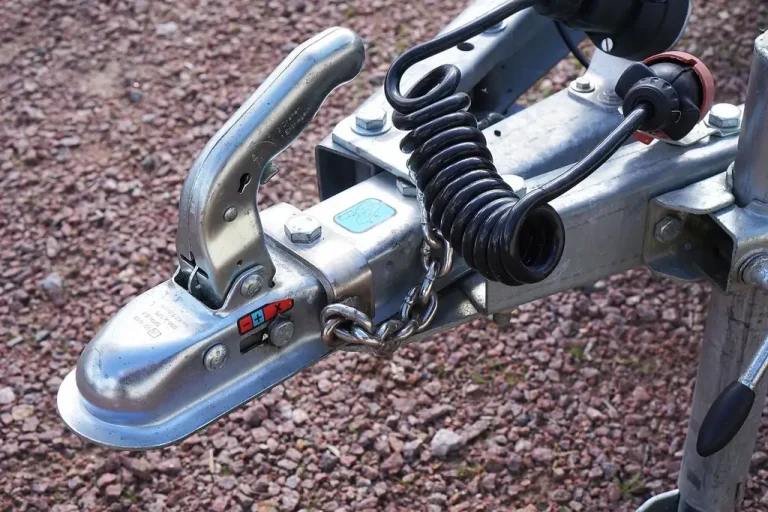
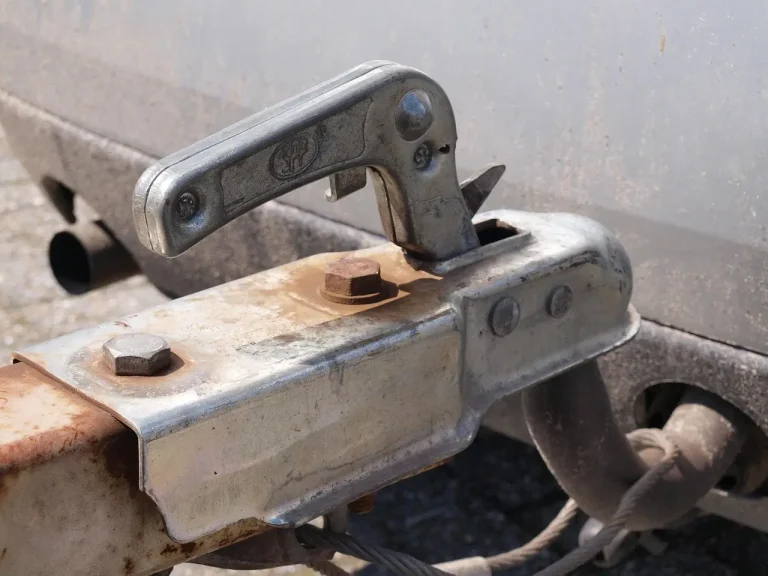
Truck lifts, leveling kits, and trailer lifts change geometry first. They change receiver height relative to the coupler, which changes the ball mount angle needed to tow level, and that can alter how load moves across the trailer axles and hitch parts even when the cargo stays the same.
Truck lift versus trailer lift
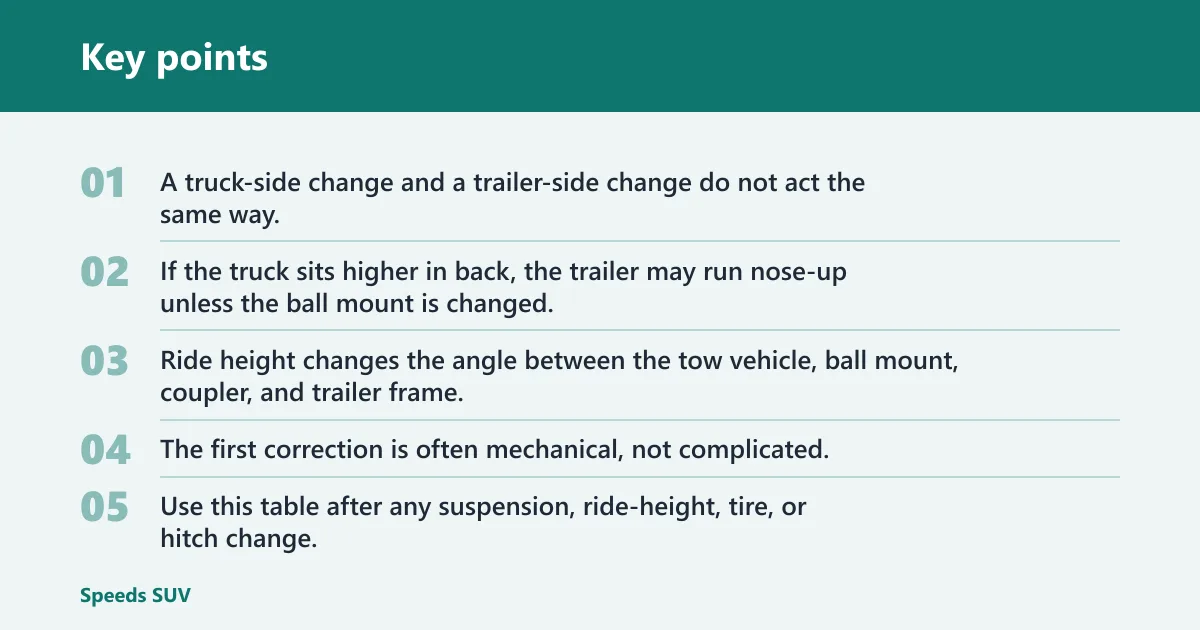
A truck-side change and a trailer-side change do not act the same way. A truck lift or leveling kit raises the receiver, so the ball may sit too high for the trailer tongue unless you change the drop or rise on the ball mount. A trailer lift raises the frame and coupler, which changes trailer attitude and can shift axle loading without changing the trailer’s cargo weight.
That difference matters because tow behavior follows geometry. If the truck sits higher in back, the trailer may run nose-up unless the ball mount is changed. If the trailer is lifted, the coupler angle may change even if the truck stays stock, and that can affect sway tendency and braking balance.
Why ride height changes hitch geometry
Ride height changes the angle between the tow vehicle, ball mount, coupler, and trailer frame. A taller receiver or a taller coupler alters the load path at the hitch, so the old tongue weight reading should not be treated as current after a geometry change.
The first correction is often mechanical, not complicated. A different ball mount drop or rise is usually the first step because it restores near-level trailer attitude and puts the hitch load path back where the trailer maker expected it.
Tongue weight audit table
Use this table after any suspension, ride-height, tire, or hitch change. It separates what changed from what you need to measure, explains why each item matters, and shows the next correction to make before towing.
| Change made | What to remeasure | What can shift | Pass/fail threshold | Why it matters | Next correction |
|---|---|---|---|---|---|
| Truck lift | Receiver height, ball mount drop or rise, tongue weight, trailer attitude | Coupler angle, rear squat, rake, hitch load path | Trailer sits near level; tongue weight stays within trailer maker target; receiver and hitch ratings are not exceeded; ball mount is pinned and torqued correctly | A taller receiver can change the tow angle and move load transfer at the hitch. | Change ball mount height first, then recheck loaded trailer attitude and tongue weight. |
| Trailer lift | Coupler height, tongue weight, axle position, trailer attitude | Nose-up or nose-down attitude, axle loading, sway tendency | Trailer is level when loaded as towed; axle loads remain within limits; coupler clears the ball cleanly; hitch hardware is secure | Raising the trailer can alter attitude and move load toward or away from the axles. | Recheck coupler height and ball mount selection, then confirm the trailer tows level. |
| Leveling kit | Receiver height, ball mount selection, trailer attitude | Front-to-rear truck rake, ball angle, load transfer | Ball mount height restored to level tow attitude; tongue weight measured again; no contact at bumper, tailgate, or jack | Leveling changes stance, which can change the hitch line even if cargo stays the same. | Verify ball height and clearances, then retest with the trailer loaded for travel. |
| Bigger tires | Receiver height, effective tow height, tongue weight, clearance | Ride height, approach angle, hitch geometry, speedometer error | Trailer still tows level; hitch and receiver clearances remain safe; tire load ratings remain adequate; tongue weight is rechecked after inflation and cargo loading | Tire size can raise the tow point and change the effective geometry at the hitch. | Measure the new tow height, then confirm trailer level and clearances at travel load. |
| Airbag helper springs | Loaded ride height, tongue weight, tow stance | Squat, pitch, weight transfer at the rear axle | Airbags do not hide an overloaded tongue; measured tongue weight stays within hitch and receiver limits; trailer remains stable under braking | Airbags can improve stance without reducing actual hitch load. | Use airbags only after confirming the loaded tongue is still within limits. |
| New ball mount | Actual drop or rise, hitch pin fit, tongue weight, trailer level | Coupler angle, load path, long-shank flex if used | Ball size matches coupler; correct torque on hardware; trailer level is restored; measured tongue weight is recorded after installation | The wrong ball height can change the trailer’s running attitude and hitch loading. | Select the proper drop or rise, then remeasure on level ground with the trailer loaded. |
Common measurement gear includes platform scales, lever-style tongue weight tools, and jack-stand style scales. A tongue weight scale is the direct way to verify actual coupler load after a geometry change. When angle checks matter, use a simple inclinometer, and keep the focus on whether the trailer sits level rather than on brand-specific product listings.
Does a lift kit change tongue weight?
A lift kit does not change trailer mass by itself, but it can change the measured tongue load at the hitch because the hitch angle and trailer attitude change. The load in the trailer has not changed, yet the way that load reaches the ball or coupler can change enough to move the reading and the towing feel.
When the measured load can shift
Measured tongue weight can shift when the trailer sits nose-up or nose-down, when the receiver is taller than before, when the ball mount length changes, or when helper springs change rear suspension position under load. Those changes affect load transfer and can move weight off or onto the tongue without changing the cargo list.
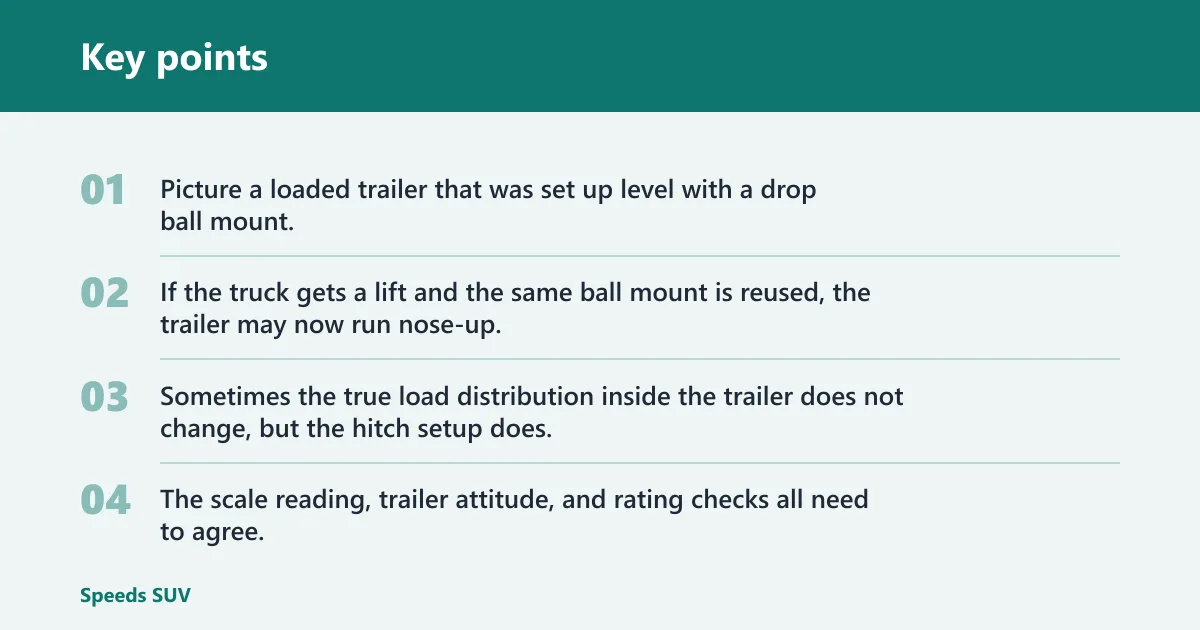
Picture a loaded trailer that was set up level with a drop ball mount. If the truck gets a lift and the same ball mount is reused, the trailer may now run nose-up. The tongue may still be loaded by the same cargo, but the hitch reading and sway behavior can change enough that the old number no longer tells you much.
When the math stays the same
Sometimes the true load distribution inside the trailer does not change, but the hitch setup does. In that case, the trailer’s internal mass balance is similar, yet the measured load at the ball can differ because the trailer is no longer level and the load path through the hitch has changed.
That is why “the trailer is still packed the same” is not enough. The scale reading, trailer attitude, and rating checks all need to agree.
How trailer attitude changes towing behavior
Trailer attitude affects more than looks. Nose-up or nose-down setup changes axle loading, braking balance, and sway tendency, so the trailer should be checked loaded as it will be towed. A level trailer is usually the starting point, not the finish line.
Nose-up and nose-down setup
A nose-up trailer often shifts more load to the rear axle group and can lighten the tongue relative to the loaded trailer weight. That can reduce stability and make sway more likely. A nose-down trailer can increase tongue load and may push too much force onto the hitch, receiver, and rear suspension.
Both conditions can hurt towing feel. Nose-up often reduces straight-line calm. Nose-down can increase squat and can make the truck’s rear suspension work harder under braking and bumps.
Sway, braking, and axle loading
Sway risk rises when tongue weight drops too low for the trailer type or when the trailer attitude changes enough to shift the load rearward. Braking balance can also change because the axle group and tongue no longer share the load the same way. That is why the trailer maker’s guidance wins over any generic rule.
A common first-timer mistake is to add a leveling kit and stop at appearance. The truck may look right in the driveway, but the trailer can still ride nose-up once loaded, and that is where the trouble starts.
How do you remeasure tongue weight?
Use a tongue weight scale after any ride-height, hitch, tire, or cargo change. Measure the trailer in the same loaded condition you tow with, because a dry reading or an unloaded reading will not show the load that actually reaches the coupler on the road.
Load the trailer fully. Put fuel, water, tools, cargo, propane, and other gear in place as you will tow it. Tongue weight should be checked with the trailer loaded as used, not in a shop-empty state.
Park on level ground. Chock the trailer wheels and keep the tow vehicle on the same surface if possible. Level ground reduces error when you compare hitch height, trailer attitude, and scale reading.
Measure the coupler load. Use a platform, lever, or jack-stand style tongue weight scale at the coupler or ball. Record the number exactly as measured, then compare it with the trailer maker’s guidance and the common 10% to 15% range for many conventional trailers.
Check the trailer attitude. Confirm whether the trailer is level, nose-up, or nose-down at towing height. If the body is not close to level, the reading may still be accurate, but the setup may still need a different ball mount height.
Verify the tow ratings. Compare the measured tongue load with the hitch rating, receiver rating, tow vehicle limits, and trailer GVWR. A weight distribution hitch can redistribute load, but it does not cancel the need to know actual tongue weight.
Say a trailer scale shows about 900 pounds after a leveling kit installation, and the trailer maker wants about 10% to 15% of loaded trailer weight. If the trailer is 6,500 pounds loaded, 900 pounds is about 13.8%, which may be acceptable if the hitch and receiver ratings also allow it. If the same trailer sits nose-up, the scale and the ratings still need to be rechecked after the ball mount is corrected.
How do you correct the setup?
Correct the geometry before you chase other symptoms. Ball mount height is the first place to start, then verify whether the trailer still tows level, and only then adjust helper springs, hitch tension, or tire pressure if needed. A weight distribution hitch helps distribute load, but it should not be used to hide a bad ball height or an out-of-range tongue load.
Ball mount drop or rise
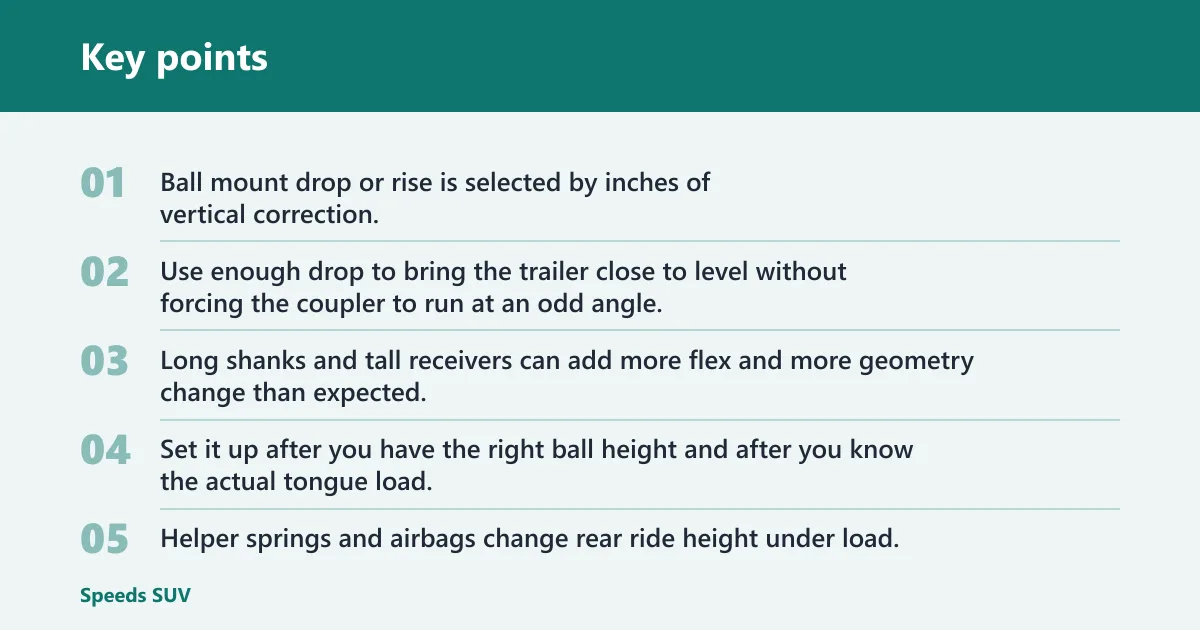
Ball mount drop or rise is selected by inches of vertical correction. Use enough drop to bring the trailer close to level without forcing the coupler to run at an odd angle. If the tow vehicle was lifted, a deeper drop may be needed; if the trailer was lifted, less drop or even rise may be the right move.
Long shanks and tall receivers can add more flex and more geometry change than expected. That matters most on heavier trailers, where a few inches of height difference can change the load path at the ball and the brake feel behind the truck.
Weight distribution hitch setup
A weight distribution hitch shifts load across the tow vehicle and trailer axles, but it does not make tongue weight disappear. Set it up after you have the right ball height and after you know the actual tongue load. If the trailer sits nose-up, spring bar tension can be misleading because the hitch is correcting a bad geometry instead of a proper one.
When helper springs or tire changes matter
Helper springs and airbags change rear ride height under load. That can improve stance, but it can also mask overload if the tongue is too heavy. Bigger tires change ride height and can change the effective receiver height, so they belong in the same recheck process as lift kits and ball mounts.
A truck with airbags set to hold the rear perfectly level can still be overloaded at the receiver. The stance may look better, but the rating math does not change.
Ratings you need to check
After any suspension or hitch change, compare the measured tongue weight against the trailer GVWR, hitch rating, receiver rating, and tow vehicle limits. Those numbers set the real ceiling. If the trailer cargo changes later, the tongue load can change too, so recheck again before towing.
GVWR and trailer weight limit
Trailer GVWR tells you the maximum legal and structural limit for the loaded trailer. Tongue weight is part of that total. If cargo shifts forward, tongue load rises; if it shifts rearward, tongue load falls and stability can suffer.
Hitch, receiver, and tow vehicle limits
The hitch rating and receiver rating are separate limits from the trailer’s own GVWR. The tow vehicle also has axle, payload, and rear suspension limits. None of those limits are changed by a leveling kit or lift kit, so they must still be respected after the body sits higher.
Axles and suspension hardware also have hard ratings of their own, separate from hitch setup, so the safest path is to keep the entire tow system within the lowest published limit.
Frequently asked questions
How does a lift kit change tongue weight?
A lift kit does not change trailer mass by itself. It changes hitch height and can change trailer attitude, which alters how the load reaches the ball or coupler. That can move the measured tongue weight and change how the trailer tows, especially if the trailer runs nose-up after the modification.
Does raising the suspension affect trailer tongue weight?
Yes, it can affect the measured tongue load and the towing setup. Raising the tow vehicle or trailer changes receiver height, coupler angle, and load transfer. The loaded trailer may still have the same cargo, but the hitch reading and stability can change enough to require a fresh measurement.
Do I need to remeasure tongue weight after suspension mods?
Yes. Any lift kit, leveling kit, helper spring change, tire-size change, or ball mount change deserves a new measurement, as these changes can affect setup. Use a tongue weight scale with the trailer loaded as towed, then compare the reading with the trailer maker’s guidance and the hitch and receiver ratings.
Can lift kits change hitch height and towing stability?
Yes. A lift kit can raise the receiver relative to the trailer tongue and force you to use a different drop or rise on the ball mount. If the trailer ends up nose-up or nose-down, stability can worsen, braking balance can shift, and sway can become more likely.
What happens to tongue weight after leveling a truck?
Leveling a truck can raise the front or change the rear stance enough to alter receiver height and tow geometry. The actual trailer cargo does not change, but the measured tongue load can shift because the trailer may no longer sit at the same angle it had before.
Does a weight distribution hitch change tongue weight?
A weight distribution hitch can redistribute load across the axles, but it does not remove the need to know actual tongue weight. You still need the measured coupler load, and you still need to stay within trailer, hitch, receiver, and tow vehicle limits after the hitch is set up.