Tongue Weight Explained for Safe Towing
Tongue weight is the trailer load pressing down at the hitch, measured with the trailer packed exactly as it will travel. A common target is usually about 10–15% of loaded trailer weight for bumper-pulls, or about 15–25% pin weight for fifth-wheel and gooseneck rigs. If hitch load is too low, the trailer is more likely to sway. If it is too high, you can exceed payload, axle, tire, or hitch ratings. This guide covers safe targets, trip-ready measuring, cargo placement, and rating checks.
The useful way to view tongue weight is as a balance problem, not a single magic number. The trailer needs enough hitch load to resist sway, the tow vehicle needs enough weight on the front axle for steering and braking, and the payload budget must still cover passengers, gear, hitch hardware, and the trailer’s hitch load.
That is why you choose the target twice: first on paper before the trip, then again on a scale with water, propane, batteries, food, tools, and cargo loaded where they will actually ride.
What is tongue weight, exactly?
Tongue weight is the trailer’s downward force at the hitch point, measured with the trailer loaded exactly as it will travel. It is different from total trailer weight, tow rating, and hitch hardware weight. The number that matters is the trip-ready hitch load, because that is the load affecting stability and payload.
Downward force at the hitch point
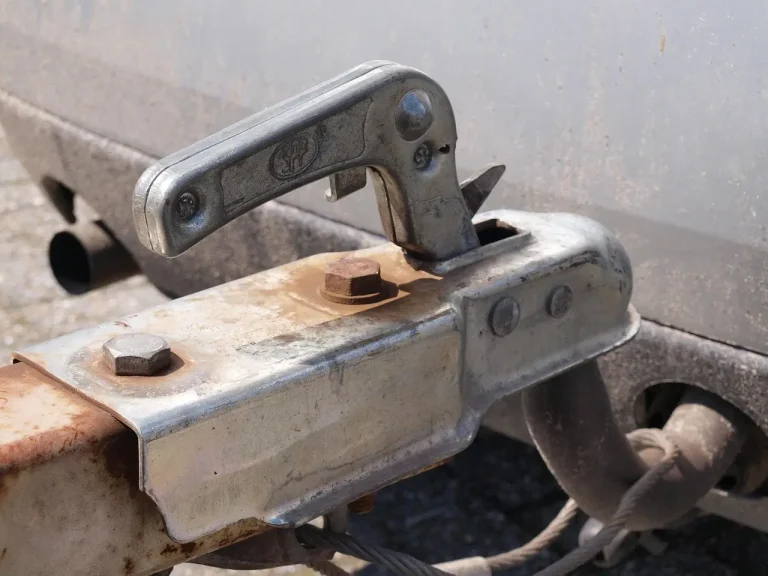
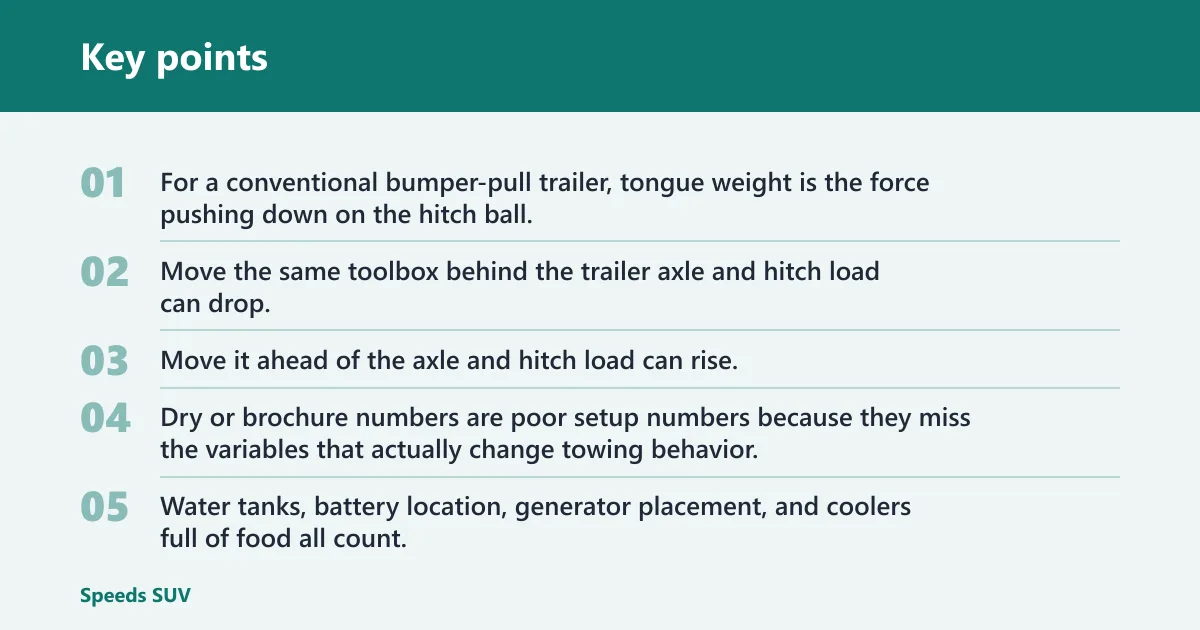
For a conventional bumper-pull trailer, tongue weight is the force pushing down on the hitch ball. For a fifth-wheel or gooseneck, the same concept applies at the hitch in the bed, though many owners call it pin weight instead of tongue weight.
That downward load affects the whole towing system. It changes front-axle load on the tow vehicle, rear-axle load, and the trailer’s resistance to sway.
Measure it loaded for travel
Loaded trailer weight is the basis for the percentage calculation, and loaded means everything that will be on board on the road: cargo, water, fuel, batteries, propane, and gear. Where that load sits matters too. Move the same toolbox behind the trailer axle and hitch load can drop. Move it ahead of the axle and hitch load can rise.
Dry or brochure numbers are poor setup numbers because they miss the variables that actually change towing behavior. Water tanks, battery location, generator placement, and coolers full of food all count.
Tongue weight vs trailer weight, tow weight, and hitch weight
Trailer weight is the whole trailer on its own tires plus its load. Tongue weight is only the portion pressing down on the hitch.
Towing capacity is the vehicle’s maximum trailer-pulling rating under its listed conditions. It does not mean the vehicle can accept any tongue load below that trailer limit. Tongue weight counts against the tow vehicle’s payload.
Hitch weight can mean different things in listings, which creates confusion. Sometimes it means the trailer’s published empty tongue load. Sometimes it means the hitch hardware itself. For setup, the number that matters is the measured trip-ready downward load at the hitch point.
Why does tongue weight matter so much?
Tongue weight matters because it changes trailer stability and tow-vehicle control at the same time. Too little tongue weight raises sway risk. Too much can lighten the front axle, add rear-axle load, and reduce steering traction and braking effectiveness. The right range keeps the rig settled without pushing past payload or hitch limits.
How it affects sway, steering, and braking balance
Conventional travel and cargo trailers are often planned around 10–15% of loaded trailer weight, and TowSense says conventional bumper-pull trailers should target 10–15% tongue weight. TowSense also recommends 12–13% as a sweet spot for most conventional trailers.
That range works in practice because many bumper-pull rigs track better with enough forward load to resist oscillation, while still leaving room inside the tow vehicle’s payload and axle ratings. Tongue weight does not work alone, but it strongly affects whether the trailer follows cleanly or starts moving around the hitch.
TowSense says too little tongue weight can create trailer sway. The same source says too much tongue weight can reduce steering traction and braking effectiveness. Those are two separate failure paths, and both matter before highway speed enters the picture.
Too little vs too much
Too little tongue weight usually feels like a nervous trailer. A crosswind, passing truck, lane change, or downhill stretch can start a tail-wagging motion that keeps building instead of fading out.
Too much tongue weight usually shows up at the tow vehicle first. The rear can sag, the front can feel light, steering response can dull, and braking balance can feel less settled because the front axle is carrying less of the work it was designed to do.
Picture a 24-foot bumper-pull loaded with camping gear, but two heavy bins get moved behind the trailer axle to make room near the front pass-through. Nothing else changes. The trailer may still be under its total weight rating, yet the lower hitch load can make it more sway-prone on the highway.
Suppose a pickup carries a family, a bed full of firewood, a heavy aftermarket topper, and then takes on a front-loaded trailer with a high hitch load. The trailer may track straight, but the truck can run out of payload or rear-axle margin before it runs out of engine.
What percent should tongue weight be?
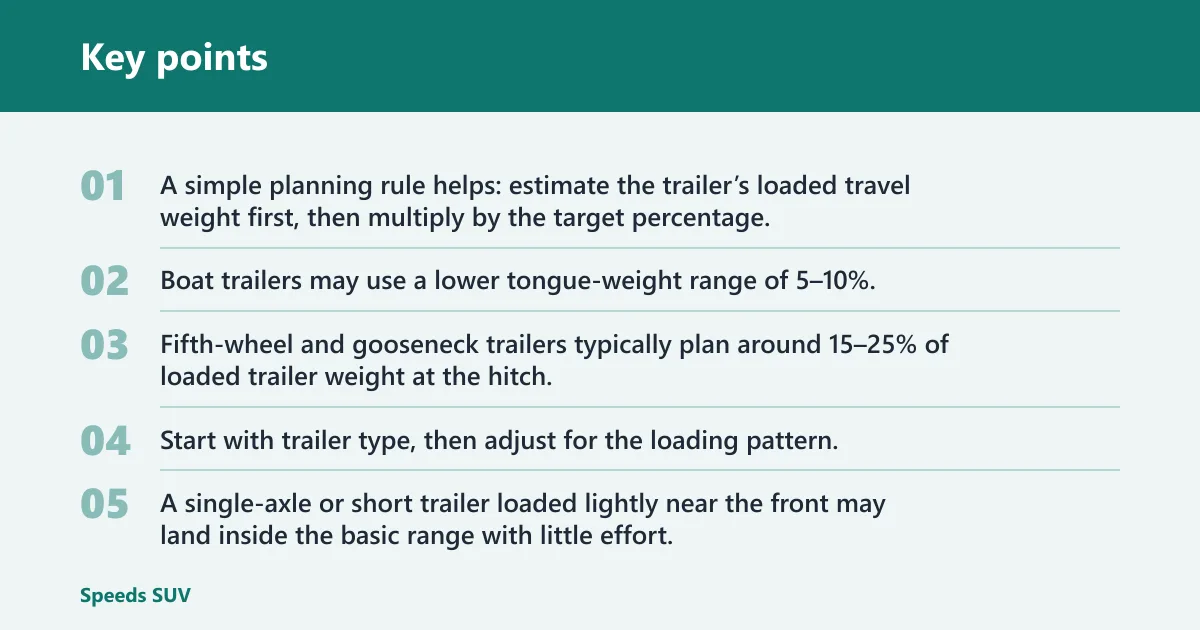
The planning range depends on trailer type. Conventional bumper-pull trailers are commonly set at 10–15% of loaded trailer weight, with 12–13% often working as a practical target. Fifth-wheel and gooseneck trailers typically run 15–25% because their hitch point sits over the tow vehicle’s rear axle area, not behind it.
Bumper-pull trailers
The same source says conventional bumper-pull trailers should target 10–15% tongue weight, and TowSense recommends 12–13% as a sweet spot for most conventional trailers. That is a target range, not a guarantee, because vehicle payload, receiver limits, tire ratings, and cargo position still decide whether the setup works.
A simple planning rule helps: estimate the trailer’s loaded travel weight first, then multiply by the target percentage. If a bumper-pull is expected to weigh about 6,000 pounds loaded for the trip, a common rule of thumb is that 12–13% points to a tongue-weight target of about 720 to 780 pounds. That is a planning number to verify after loading.
Boat trailers may use a lower tongue-weight range of 5–10%. That lower range is trailer-type specific and should not be carried over to ordinary travel trailers or enclosed cargo trailers.
Fifth-wheel and gooseneck trailers
Fifth-wheel and gooseneck trailers typically plan around 15–25% of loaded trailer weight at the hitch. Their hitch point is farther forward relative to the trailer body and much closer to the tow vehicle’s rear axle, so their stable operating range differs from a bumper-pull’s 10–15% target.
That higher percentage does not make payload easier. It often makes payload the first limit to check, especially with diesel engines, crew cabs, passengers, and bed cargo already using much of the truck’s allowance.
Choose a target before you tow
Start with trailer type, then adjust for the loading pattern. A single-axle or short trailer loaded lightly near the front may land inside the basic range with little effort. A longer tandem-axle camper with rear storage, bikes, and a full rear cargo tray may need much closer attention to stay near that common 12–13% bumper-pull target.
Heavy items should be loaded low and forward, but only to the point where all ratings still work. Forward loading raises tongue weight. Rear-heavy loading reduces it. The goal is a stable percentage that also fits the tow vehicle and hitch system.
How tongue weight uses up payload
Why tongue weight competes with people and cargo
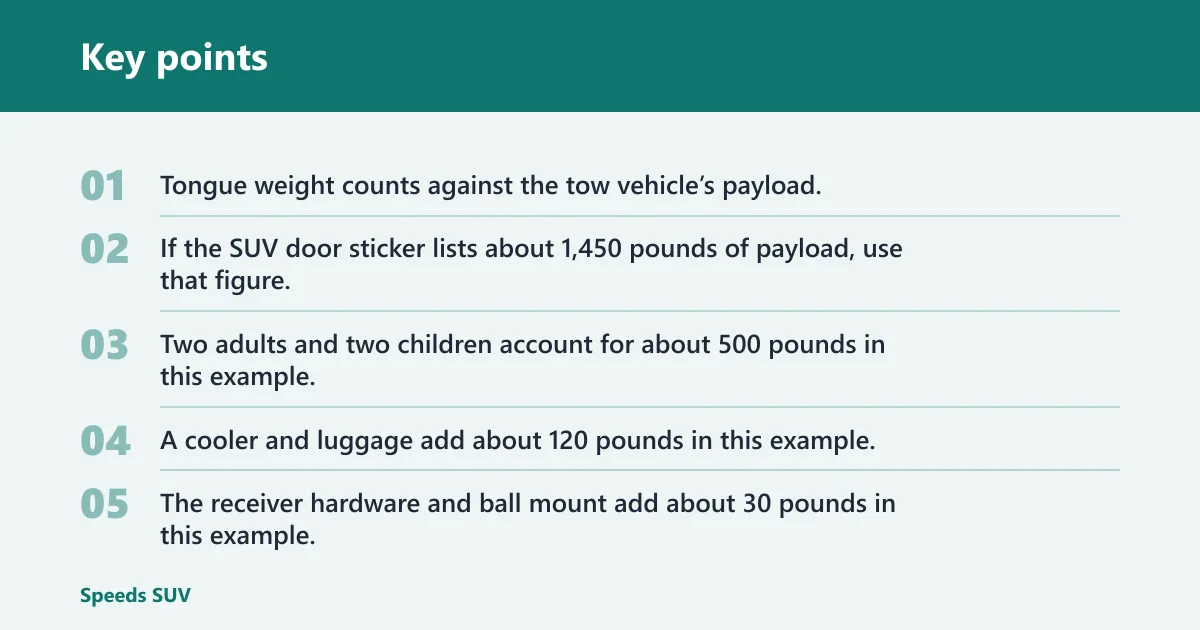
Tongue weight counts against the tow vehicle’s payload. So do passengers, cargo in the cabin or bed, hitch hardware, and added accessories such as bed covers, toolboxes, running boards, and winches if they were not included in the vehicle’s actual payload sticker calculation.
This is where many apparently capable tow vehicles get boxed in. A trailer can be under the vehicle’s tow rating and still overload payload, rear axle, receiver rating, or rear tires once the measured hitch load is added.
A real-world payload budget
If the SUV door sticker lists about 1,450 pounds of payload, use that figure. Two adults and two children account for about 500 pounds in this example. A cooler and luggage add about 120 pounds in this example. The receiver hardware and ball mount add about 30 pounds in this example. That leaves 800 pounds before the trailer is coupled.
If the loaded bumper-pull trailer comes in at 6,200 pounds and is targeted at 12–13%, the planning tongue-weight window is 744 to 806 pounds. Even before bicycles or a dog crate are added to the SUV, the payload budget is nearly used up.
That example shows the systems problem clearly. The trailer can sit within the common bumper-pull percentage range and still be a poor match for the tow vehicle once passengers and vehicle cargo are counted.
Limits that can fail first
Payload is the broadest cap, but it is not the only one. Receiver ratings, rear-axle ratings, and tire load limits can be the first numbers exceeded when tongue weight is high.
A weight distribution hitch redistributes tongue weight across axles. It can help restore balance, and many systems also include sway control. It does not create extra payload or raise the vehicle’s ratings. If the measured tongue load and onboard cargo already exceed the sticker limits, hitch hardware cannot solve that math.
How to choose a safe tongue weight target
The safest tongue weight target usually starts with the trailer’s layout: lighter, shorter, and well-balanced trailers can often stay near 10–12%, while longer or sway-prone trailers usually need more, closer to 13–15%. The goal is simple: enough downward force for stable tracking, but not so much that you eat up payload or overload the rear axle.
This tongue weight guide explains how to choose between 10%, 12–13%, and 15% based on stability needs, payload limits, and cargo placement, so you can set up the trailer with fewer guesses and a better chance of towing safely.
How cargo placement changes the number
Forward and low is the starting point
Heavy trailer items should be loaded low and forward. That placement tends to support a healthy tongue-load percentage and keeps mass lower in the chassis, which helps the trailer stay settled over bumps and during steering inputs.
“Forward” does not mean jam everything at the nose. Front-heavy loading increases tongue weight and can overload payload, the rear axle, rear tires, the receiver, or hitch components. The trailer still needs to land in the target range after all travel gear is aboard.
Rear-heavy loading reduces tongue weight
Rear-heavy loading cuts tongue weight because it shifts mass behind the trailer axle group. That reduces force on the hitch and makes the trailer easier to yaw around the ball, which raises sway risk.
A common first-timer mistake is loading generators, firewood, or a full cargo box at the trailer’s rear bumper because the area is easy to access. Total trailer weight may rise only modestly, but the drop in hitch load can move the setup from calm to twitchy.
Small shifts can matter
Picture a travel trailer with two full propane cylinders and batteries already mounted at the tongue. It tows well with a full front pass-through. Then a heavy tool bag, portable grill, and two cases of drinks get moved to the rear storage area to free up front space. Nothing changed in total trailer weight, but the hitch load can fall enough to change how the trailer reacts to wind.
That is why the final check happens after packing. Water, propane, batteries, food, and gear do not simply add weight. They change where the trailer carries that weight.
How do you measure tongue weight?
The best method depends on expected load and available tools, but the measurement must be taken with the trailer loaded for the trip and parked on level ground. A dedicated tongue weight scale is usually the most accurate home method. Public truck scales are a good alternative when a dedicated scale is unavailable.
Compare the common methods
A dedicated tongue weight scale is usually the most accurate home method because it measures the hitch load directly. Its capacity should exceed the expected tongue load. Mechanical and built-in hitch versions are common.
Rollo Tire lists a Fastway Simple WEIGH tongue weight scale with 2,100 pounds capacity. The same source lists a Sherline LM 2000 trailer tongue weight scale with 2,000 pounds capacity. The same source lists a Weigh Safe fixed-height ball mount rated for 1,500 pounds tongue weight. The same source lists a Rigid Hitch trailer weight tongue scale with 5,000 pounds capacity.
Bathroom-scale-style methods can work for lighter loads when used with a lever arrangement, but scale capacity is usually the weak point. Uneven ground, a jack that binds, or geometry errors can also skew the result. For heavier travel trailers, a purpose-built scale or public scale is the better path.
A public weigh station or CAT scale is useful when no dedicated tongue scale is available. It also helps confirm total trailer weight and tow-vehicle axle loads, which matter as much as the hitch load itself.
Measure at home or on a public scale
- Load for travel. Fill or empty water to the exact trip plan, install batteries, load propane, food, tools, and camping gear, and place cargo where it will ride. Tongue weight changes with both amount and position of load, so a half-packed trailer gives a half-useful number.
- Park on level ground. Keep the trailer level front to rear and side to side as closely as possible. A nose-high or nose-low attitude changes the force at the hitch and can mislead the result.
- Check scale capacity. Confirm that the tongue weight scale, built-in hitch scale, or bathroom scale setup can exceed the expected hitch load. Over-capacity measurements are unsafe and often inaccurate even before a scale is visibly overloaded.
- Measure the hitch load. For a dedicated scale, place it under the coupler or jack point exactly as the manufacturer intends. For a built-in hitch scale, couple normally and read the indicator on level ground. For a public scale, weigh the tow vehicle and trailer in a repeatable sequence so the tongue contribution can be calculated against axle loads.
- Verify the whole setup. Compare the measured tongue weight with the loaded trailer weight, then check payload, receiver rating, rear-axle load, and tire capacity. A good tongue-weight percentage is only good if every related rating still works.
- Recheck after changes. Re-measure after adding water, moving bins, mounting bikes, or filling rear storage. Small loading changes are enough to move a bumper-pull out of its stable target range.
Tongue weight decision table
| Trailer type | Loaded-weight target range | Common failure sign | Measurement method | Weight distribution hitch worth considering? |
|---|---|---|---|---|
| Conventional bumper-pull travel trailer | 10–15% of loaded trailer weight; 12–13% is a common planning target | Sway or tail-wagging if tongue load is too low; rear sag or light steering if too high | Dedicated tongue weight scale first; public scale to confirm trailer and axle loads | Yes, especially if tongue weight exceeds about 500 lbs or the tow vehicle shows sag or light steering |
| Enclosed cargo trailer, bumper-pull | 10–15% of loaded trailer weight | Nervous tracking after gear shifts rearward | Dedicated tongue scale or built-in hitch scale; public scale for business loads that vary often | Often worth considering once hitch load gets heavy relative to payload or receiver limits |
| Boat trailer | 5–10% of loaded trailer weight | Bow-heavy or stern-heavy load balance changing ramp and highway behavior | Built-in hitch scale or public scale if trailer geometry makes direct measuring awkward | Sometimes, but less common than with travel trailers |
| Fifth-wheel trailer | 15–25% of loaded trailer weight at the hitch | Truck payload exhausted before trailer tow rating is reached | Public scale is often the clearest way to verify truck axle loads and hitch load effect | No conventional weight distribution hitch; focus on payload, axle, tire, and hitch ratings |
| Gooseneck trailer | 15–25% of loaded trailer weight at the hitch | Rear-axle or tire overload from concentrated bed load | Public scale or integrated hitch/load reading system | No conventional weight distribution hitch; rating checks matter more |
When a weight distribution hitch makes sense
What it does and when to consider one
A weight distribution hitch redistributes tongue weight across axles. That can help return load to the tow vehicle’s front axle and reduce the rear-heavy stance that comes with higher bumper-pull tongue loads.
The same source says you should consider a weight distribution hitch when tongue weight exceeds about 500 lbs. That is a practical trigger, not an automatic requirement. If the tow vehicle shows rear sag, light steering, or reduced braking confidence, the case gets stronger.
What it cannot do
Some weight distribution hitches include sway control, which can improve damping in the system. That helps manage trailer behavior, but it does not erase the need for proper tongue weight or correct cargo placement.
Most important, a weight distribution hitch does not increase payload or any vehicle rating. If the payload sticker, receiver limit, axle rating, or tire capacity is already exceeded, the answer is less load, different load placement, or a more suitable tow vehicle.
Pre-trip tongue weight check
Quick verification before departure
- Match the trip load. Confirm water, propane, batteries, food, tools, recovery gear, and coolers match the actual travel plan. Tongue weight measured before tanks or gear are added is often the wrong number.
- Inspect cargo placement. Keep dense items low and forward, then confirm rear storage has not become the default home for heavy gear. This step catches the common habit of moving weight rearward late in the packing process.
- Measure the tongue load. Use the same method on the same level surface whenever possible. Consistency matters because small changes can be meaningful near payload or receiver limits.
- Run the payload math. Add passengers, pets, cargo in the tow vehicle, hitch hardware, and measured tongue weight against the payload sticker. Then confirm receiver, axle, and tire ratings still have room.
- Set up the hitch. If using weight distribution, tension it according to the hitch maker’s procedure and recheck the tow vehicle’s stance. The hitch should redistribute load across axles, not hide an overloaded setup.
- Watch for symptoms. If the rear squats excessively, the steering feels light in the driveway, or the trailer attitude is nose-high, stop and correct the setup before heading onto faster roads.
Frequently asked questions
How does tongue weight affect towing?
Tongue weight changes both trailer stability and tow-vehicle balance. Too little raises sway risk because the trailer has less downward load at the hitch. Too much can overload payload, rear axle, receiver, or tires, while also reducing front-axle loading enough to hurt steering feel and braking balance.
Tongue weight vs towing capacity
Towing capacity is the maximum trailer weight a vehicle is rated to pull under specified conditions. Tongue weight is the downward load the trailer puts on the hitch. A rig can be under tow rating and still be overloaded if measured tongue weight, passengers, and cargo exceed payload or hitch-related limits.
Tongue weight vs trailer weight
Trailer weight is the whole loaded trailer. Tongue weight is only the portion of that load carried by the hitch. The usual tongue-weight percentage is calculated from loaded trailer weight, not empty weight, which is why cargo, water, propane, batteries, and gear must be included before measuring.
Tongue weight vs hitch weight
In casual use, hitch weight often means tongue weight, but listings can blur the terms. Some brochures use hitch weight for an empty trailer’s published downward load. Some owners use it for hardware weight. For towing setup, the key number is the measured trip-ready downward force at the hitch point.